Our review
Cash settlements have become a popular tool for insurers when dealing with home building insurance claims. About two thirds of home building insurance claims in Australia now include a cash component.
Consumers can be attracted to the speed of cash payouts, which are usually processed faster than the time insurers take to arrange building work. But a lack of reliable data makes it hard to know what is driving the trend: only one insurer in our review could readily extract data on the reason a claim was cash settled and no insurer captured this systematically.
ASIC is concerned that the use of cash settlements might be resulting in unfair outcomes for consumers who need to make a home building insurance claim.
Specific risks to consumers include inadequate cash settlements that do not cover the true cost of the repairs, the stress of finding reliable tradespeople and supervising repairs, and not receiving lifetime repair guarantees.
Our findings are based on a review of the industry’s use of cash settlements in home building insurance claims arising from Cyclone Jasper (CAT232) – which caused significant damage in Far North Queensland in December 2023 – and any updates made by insurers to their practices since then.
We collected data and reviewed the policies, procedures, training materials and a sample of claim files from the following entities that represent a majority of the home insurance industry:
- Insurance Australia Group (IAG; includes Insurance Manufacturers of Australia Pty Ltd and Insurance Australia Limited);
- AAI Limited
- QBE Insurance (Australia) Limited
- Allianz Australia Insurance Limited, and
- Sure Insurance Pty Ltd.
(collectively, ‘insurers’)
We found that most home insurance claims in our review involved a cash settlement, and that often consumers were not being provided with enough information to determine whether the acceptance of a cash settlement was in their best interests.
These findings are consistent with the findings we made last year as part of our follow up work to Report 768 Navigating the storm: ASIC’s review of home insurance claims (REP 768). They also echo the recommendations made by the House of Representatives Standing Committee on Economics in its October 2024 Flood failure to future fairness report on providing greater detail and clarity to consumers about cash settlements.
Our findings
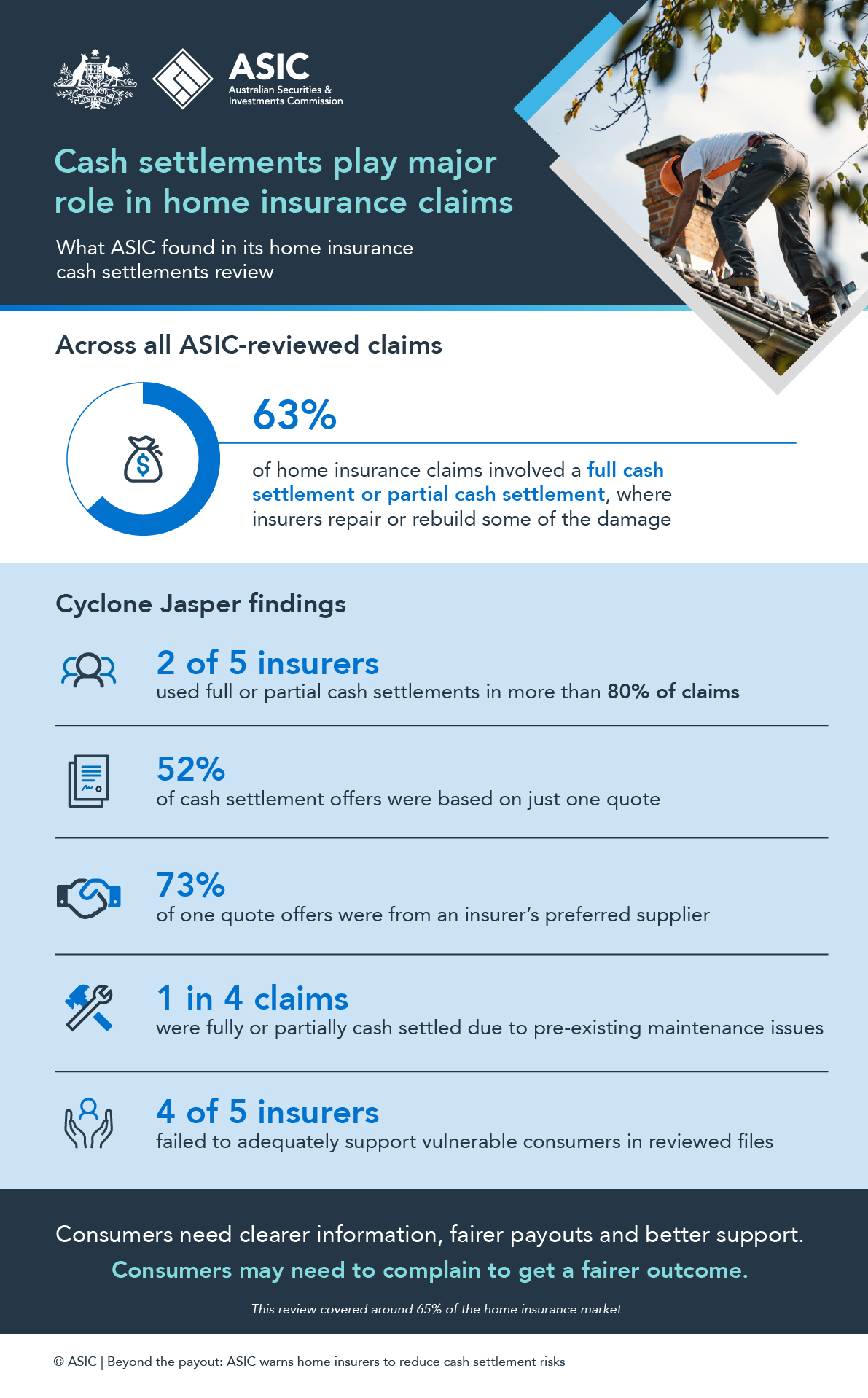
Infographic: Cash settlements play major role in home insurance claims - text version
What ASIC found in its home insurance cash settlements review
Across all ASIC-reviewed claims
63% of home insurance claims involved a full cash settlement or partial cash settlement, where insurers repair or rebuild some of the damage
Cyclone Jasper findings
- 2 of 5 insurers used full or partial cash settlements in more than 80% of claims
- 52% of cash settlement offers were based on just one quote
- 73% of one quote offers were from an insurer’s preferred supplier
- 1 in 4 claims were fully or partially cash settled due to pre-existing maintenance issues
- 4 of 5 insurers failed to adequately support vulnerable consumers in reviewed files
Consumers need clearer information, fairer payouts and better support.
Consumers may need to complain to get a fairer outcome.
This review covered around 65% of the home insurance market
ASIC’s 2026 review found that:
- at least 63% of final home insurance claims included a cash settlement
- cash settlement offers were often based on quotes from preferred suppliers, making us concerned about whether those amounts were enough to cover the cost of repairs
- consumers needed more information to help understand what the settlement included and what their review rights were
- vulnerable consumers were not always identified and adequately supported, and
- insurers did not collect enough data about cash settlements. For example, while they typically had data on the dollar amount, there was a lack of available data about how that offer changed through the claims process and the reasons why.
Finding 1: Most claims involve a cash settlement
All insurers in the review noted their preference for settling claims by managing repairs or rebuilding rather than with cash.
However, the data told a different story.
At least 63% of all claims for both CAT232 and during a normal operating period involved a full or partial cash settlement. Additionally, two of the five insurers reported that they used full or partial cash settlements in more than 80% of claims related to CAT232.
| Entity | Full cash settlement (%) | Part cash settlement and part repair/rebuild (%) | Full repair/rebuild (%) |
|---|---|---|---|
| AAI | 29 | 46 | 24 |
| Allianz | 30 | 51 | 19 |
| IAG | 38 | 44 | 18 |
| QBE | 12 | 59 | 28 |
| Sure | 30 | 24 | 46 |
While insurers said they preferred to manage repairs, we found that where claims involved pre-existing maintenance issues, insurers tended to offer cash settlements. That was particularly true when the pre-existing issues could not be rectified in a timely manner.
According to insurers’ data, maintenance exclusions (i.e. situations where the insurer declined to cover some of the damage because the building had not been properly looked after, repaired, or maintained over time) were the underlying reason for a quarter of CAT232 cash settlements.
At the individual claim level, half of the files that we reviewed involved a cash settlement due to the insurers’ assessment that the consumer had not adequately maintained their property.
Insurers should work with consumers where there is excluded damage

Poor practice:
One insurer accepted a claim for interior water damage near a number of windows. However, it found pre-existing maintenance issues relating to the external seal on those windows.
The insurer offered a cash settlement without attempting to work with the consumer to rectify the maintenance issues first.
The consumer was left to find their own workers to address both the maintenance issues and the insured components.

Better practice:
While assessing damage to the roof, the insurer identified rust that was not covered under the policy.
Despite this, the insurer offered to obtain a quote for both the insured and uninsured works and, as long as the consumer paid for the maintenance works, the insurer would manage all repairs through their builder.
This approach is better practice. It allows all the related works to be completed by one builder, making the process simpler for the consumer.
Finding 2: Cash settlement amounts may be unfair
Cash settlements should cover the full cost of the repairs. Insurers should not offer cash settlements that do not allow consumers to have the damage repaired in full.
We found that in 52% of CAT232 claims, insurers relied on a single quote to make their cash offer. While this can help expedite the claims process, insurers reported that 73% of claims involving one quote were from the insurers’ preferred supplier. It is generally accepted practice for preferred suppliers to discount pricing for insurers in exchange for repeat business. However, if the consumer is not able to engage a supplier at that rate, the cash settlement may not be enough to cover the cost of repairs.
An effective way for insurers to address this issue is by applying a contingency to cash settlements. A contingency (or loading) is a percentage added to quotes to compensate for discounts received by insurers, and for the risks consumers assume when accepting a cash settlement.
Our review found that no insurer had a consistent policy of applying contingencies to preferred supplier quotes.
One insurer applied a contingency of 10% to one claim but did not apply it to other claims we reviewed. Another insurer applied a contingency of 20% after the consumer lodged a complaint. In two instances where the insurer obtained more than one quote for repairs, insurers offered to settle on the lowest quote.
Only one insurer reported adopting a cost-plus pricing model to ensure (as with a contingency percentage) that a preferred supplier’s quote reflects market rates for labour and materials.
Cash settlements should cover the cost of repairs
Poor practice:
One insurer offered a cash settlement based on a preferred builder’s quote. When the consumer asked the builder whether they would do the repairs for that amount, the builder told them they could not as they had undercut their costs by 40% for the insurer.
After the consumer lodged a complaint, the insurer increased the offer by 16.5% plus an additional 20% for contingencies.
Consumers should not have to lodge a complaint to get a fair outcome.
Better practice:
Another insurer piloted a program to follow up with consumers six months after a cash settlement to check on the progress of repairs and adequacy of the amount.
This proactive approach supports good consumer outcomes, helps ensure properties remain insurable, and reduces complaints by monitoring cash settlement results.
Finding 3: Disclosure remains insufficient
When insurers offer to cash settle all or part of a claim and another settlement option – such as insurer-managed repairs – is also available, they must provide consumers with a Cash Settlement Fact Sheet so the consumer can make an informed choice on whether to accept the cash settlement.
We found that when making a cash settlement offer, all insurers provided consumers with a Cash Settlement Fact Sheet.
However, in an example of inaccurate disclosure, we saw one insurer list an alternative to a cash settlement which was not in fact available to the consumer. A Cash Settlement Fact Sheet which lists settlement alternatives which are not actually available can create confusion in a process that is already difficult for consumers to navigate.
Insurers have taken steps to help consumers understand the implications of a cash settlement. Most of the insurers in our review provided additional information about the risks that consumers take on.
But while disclosure has improved, the quality and clarity of explanations varied.
For example, while the policies of three insurers allowed consumers to change their mind after accepting a cash settlement, we found this was not communicated to the consumer at the time.
Since CAT232, two insurers have advised ASIC that updates have been made to expressly inform consumers of their review rights after accepting a cash settlement.
Insurers should provide detail about cash settlement components
Poor practice:
Four of the insurers issued a Cash Settlement Fact Sheet with little to no additional explanation of what the cash settlement amount covered.
Three referred to the builder’s quote and the other simply noted ‘cost of repair’ or ‘cash settlement for repair or replacement’.
Lack of detail makes it difficult for a consumer to understand what has been included if they find further damage later down the track.
Better practice:
Two insurers referred to builders’ quotes but also noted in plain English what was covered by the cash settlement offer, with a breakdown for each component. For example, one cash settlement offer was for the ‘solar system replacement’ and ‘hot water system replacement’.
The practice of these insurers was better in that it offered more detailed information that was easy to understand.
Finding 4: Vulnerable consumers still an afterthought
Vulnerable consumers often need additional support, especially when a cash settlement is offered. A consumer’s unique circumstances may heighten the risks of cash settlement and impact on whether such a settlement is in their best interests.
Although all insurers have policies and training on dealing with vulnerable consumers, we identified flaws in how four of the five insurers applied those polices. For example, certain circumstances that might have suggested vulnerability were missed and even when identified, some of the insurers did not record the information or share it with third parties involved in the claim process.
One insurer told us that they introduced standardised templates to share vulnerability information with suppliers in late 2024. This contributed to a positive claims experience in one claim.
Lack of support for vulnerable consumers makes the claims process difficult for those people, causing unnecessary stress and frustration during an already challenging time.
Insurers should do more to identify and support vulnerable consumers
Poor practice:
One insurer failed to identify the consumer as vulnerable, even though the consumer repeatedly stated that they were not comfortable with technology, could not use the app and needed phone contact. The insurer continued to send automated app messages and the consumer dealt with over twenty claims consultants during the claim process. They were repeatedly asked for a list and photos of their possessions.
The insurer recognised the consumer’s vulnerability only late in the process and acknowledged the repeated requests and multiple communications caused additional stress.
Better practice:
A consumer lodged a claim for water damage requiring mould remediation and long-term temporary accommodation. Although vulnerability was not initially identified, as circumstances changed, the insurer recognised multiple vulnerabilities (which included bereavement, medical and remoteness factors) and assigned a dedicated claims consultant.
Part of the claim was settled with a cash payment for damage not caused by the event. While the insurer could have declined this portion of the claim, it made a business decision to accept it.
At claim finalisation, the consumer wrote to thank the insurer for how it handled the claim.
Finding 5: Cash settlement data inadequate
ASIC found that most insurers were unable to readily extract key information on cash settlements from their systems. Instead, they relied heavily on manual reviews of individual claim files. If insurers are not adequately gathering and analysing data on their use of cash settlements, it will be difficult for them to understand claim outcomes, identify outliers, and detect systemic issues.
While some insurers indicated they had made changes to their data capabilities since CAT232, there is still significant scope to strengthen insurers’ ability to track data related to cash settlements.
Insurers should collect data on cash settlements
Poor practice:
No insurer systematically captured the reason a claim was cash settled.
One insurer reported that, as of March 2026, the information was manually recorded but readily available.
Other insurers advised that the information was manually recorded and not readily available.
Better practice:
One insurer introduced a new cash settlement quality report in 2026 to capture the trends in cash settlements from its own claims data.
But in addition to such high-level statistics, insurers need to collect robust data on cash settlements to ensure thorough oversight of cash settlement outcomes.
Insurers’ obligations
Insurers must ensure that any cash settlement offer is fair. If a cash settlement is not the only way to resolve a claim, insurers must provide a Cash Settlement Fact Sheet setting out:
- what options are available to the consumer
- the sum insured amount under the policy
- the amount of the total offer, with a breakdown showing each component
- a statement that the consumer should consider obtaining independent advice before accepting the offer, and
- an outline of the consumer’s review rights.
All insurers, not just those in our review, should consider how to apply the findings of this review to improve their cash settlement practices. Insurers will be in a better position to demonstrate compliance with their legal obligations if they:
- improve support for consumers where they propose to exclude some damage from a claim
- ensure cash settlement offers are based on prices that the consumer can realistically obtain in the open market
- give consumers the information they need to make an informed decision about cash settlement offers and what they can do if they disagree with the offer, change their mind, or find further damage
- ensure vulnerable consumers are identified correctly and supported throughout the claim, including by third party suppliers, and
- collect detailed data about all cash settlements to enable systematic monitoring and review of cash settlement outcomes across portfolios.