ASIC has published a new report and data examining insolvent liquidation processes and outcomes for creditors, employees, directors and liquidators.
Report 843 Review of court and creditors’ voluntary liquidation process: 2021–2025 (REP 843) examined 26,664 grouped appointments (7,023 court liquidations and 19,641 creditors’ voluntary liquidation (CVLs)) for the period 1 July 2021 to 30 June 2025. This is the first time ASIC has published this level of detail on court and creditors’ voluntary liquidation processes.
The report provides insights into the characteristics of companies entering liquidation, the assets available, returns to creditors, liquidator remuneration and use of simplified liquidation.
ASIC Commissioner Kate O’Rourke said, ‘This report provides a more detailed picture of court and creditors’ voluntary liquidations, the companies using those processes, and the outcomes achieved.'
Insights from ASIC’s review
Many companies in the review were small in financial and operational scale, with limited assets available by the time they entered liquidation. Around half of all liquidations realised no more than $10,000 in assets, and around one-quarter realised no assets.
Limited funds, together with evidentiary and commercial considerations, affect the investigations and recovery actions a liquidator can reasonably pursue and the returns available to creditors.
The review also found that:
- Around one in five appointments involved a company with at least one director who had previously been a director of another company when it entered liquidation.
- The median age of a company entering liquidation was seven years, with 60.9% of appointments involving companies aged six years or more.
- Around 69% reported liabilities of less than $1 million and 89.6% had five or fewer employee creditors. Liabilities reported by companies entering liquidation remained relatively stable across the review period, with median liabilities ranging between $410,000 and $530,000.
- Limited assets also affected the work and remuneration of liquidators. In 88.1% of finalised liquidations, no dividend was paid to ordinary unsecured creditors and either no remuneration was approved or remuneration paid to the liquidator was less than the amount approved. This indicates that unrecovered remuneration was likely common.
- The simplified liquidation process, introduced in 2021, continues to be used rarely. Only eight simplified liquidations were adopted in 2024–25, equivalent to around 0.2% of CVLs with reported liabilities not exceeding $1 million. Liabilities not exceeding $1 million are only one of several statutory eligibility criteria.
The findings are consistent with the position expressed in ASIC’s submission to the Productivity Commission’s inquiry into reducing barriers to business dynamism in Australia that there are opportunities to improve access to the simplified liquidation process. Where the statutory eligibility criteria are met, simplified liquidation can provide a more efficient, timely and cost-effective process for winding up an eligible company, while retaining appropriate protections for creditors.
Acting early when a company is in financial difficulty
The review also reinforces the importance of company directors monitoring their company’s financial position and responding early when financial difficulties emerge.
‘Directors should closely monitor their company’s financial position and seek advice early when financial difficulties arise,’ Commissioner O’Rourke said.
‘Taking action early gives a company more options to address financial difficulties. The longer action is delayed, the fewer options may remain to restructure the business, preserve value or limit further losses to creditors.’
Alongside the report, ASIC has published a new online learning module in its Small Business Director Essentials hub to help small business directors identify signs of financial difficulty and understand the steps they can take to respond early.
ASIC publishes data pack on the liquidation process
ASIC has made available a supporting data pack, Report 843 Review of court and creditors’ voluntary liquidation process: 2021–2025 – Data pack.
The data pack provides detailed aggregate data and allows users to filter information by characteristics of interest, appointment type (court liquidations compared to CVLs), available assets, creditor profile and other factors.
The data pack is intended to help registered liquidators, industry bodies, academics, policymakers and other stakeholders to better understand how the liquidation process works and its outcomes.
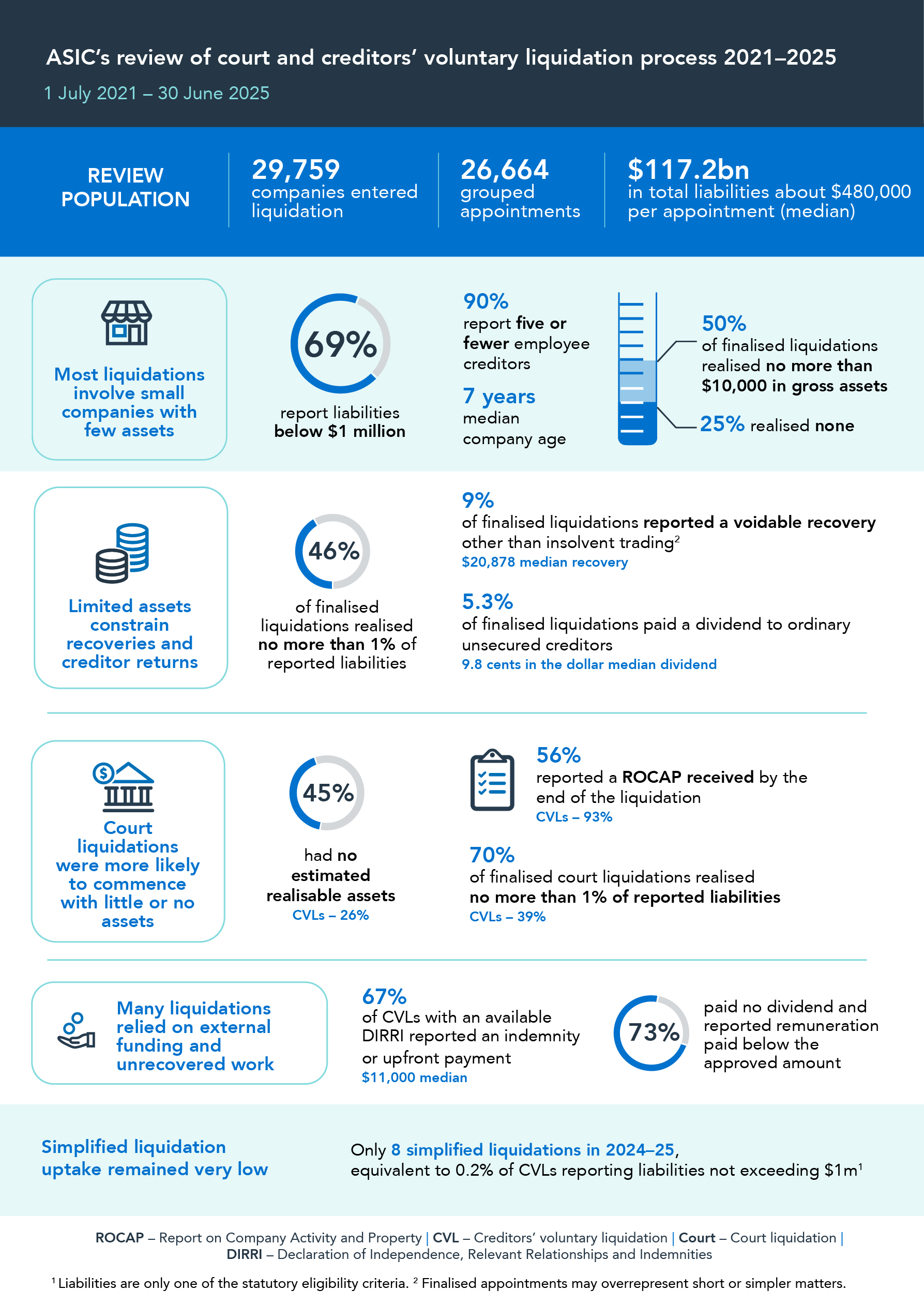
ASIC’s review of court and creditors’ voluntary liquidation process 2021–2025 – text version
1 July 2021 – 30 June 2025
Review population
- 29,759 companies entered liquidation
- 26,664 grouped appointments
- $117.2bn in total liabilities about $480,000 per appointment (median)
Most liquidations involve small companies with few assets
- 69% report liabilities below $1 million
- Around 90% report five or fewer employee creditors
- 7 years median company age
- 50% of finalised liquidations realised no more than $10,000 in gross assets
- 25% realised none
Limited assets constrain recoveries and creditor returns
- 46% of finalised liquidations realised no more than 1% of reported liabilities
- 9% of finalised liquidations reported a voidable recovery other than insolvent trading2. $20,878 median recovery
- 5.3% of finalised liquidations paid a dividend to ordinary unsecured creditors. 9.8 cents in the dollar median dividend
Court liquidations were more likely to commence with little or no assets
- 45% had no estimated realisable assets. CVLs – 26%
- 56% reported a ROCAP received by the end of the liquidation. CVLs – 93%
- 70% of finalised court liquidations realised no more than 1% of reported liabilities. CVLs – 39%
Many liquidations relied on external funding and unrecovered work
- 67% of CVLs with an available DIRRI reported an indemnity or upfront payment. $11,000 median
- 73% paid no dividend and reported remuneration paid below the approved amount
Simplified liquidation uptake remained very low
Only 8 simplified liquidations in 2024–25, equivalent to 0.2% of CVLs reporting liabilities not exceeding $1m1
Glossary
- ROCAP – Report on Company Activity and Property
- CVL – Creditors’ voluntary liquidation
- Court – Court liquidation
- DIRRI – Declaration of Independence, Relevant Relationships and Indemnities
1 Liabilities are only one of the statutory eligibility criteria.
2 Finalised appointments may overrepresent short or simpler matters.
Background
The review forms part of ASIC’s ongoing work to make available high-quality and granular data on insolvency and insolvency processes.
This report and data pack builds on ASIC’s previous work to provide greater insight into how Australia’s insolvency system is working, including our 2024 review of simplified liquidations (24-175MR), 2025 review of the small business restructuring process (25-111MR) and 2026 review of the voluntary administration and deed of company arrangement process (26-144MR).
Downloads
- Report 843 Review of court and creditors’ voluntary liquidation process: 2021–2025 (REP 843)
- REP 843 Data pack
- REP 843 infographic: ASIC's review of court and creditors’ voluntary liquidation process: 2021–2025 (PDF 491 KB)
- Online learning module: Responding to financial difficulty earlier