ASIC has published a new report and data examining the small business restructuring (SBR) process and outcomes across the first five years of the regime’s operation.
Report 847 Review of small business restructuring process: 2021–26 (REP 847) examined 6,606 appointments that commenced during the period 1 January 2021 to 30 June 2026.
ASIC Commissioner Kate O’Rourke said, ‘Five years after its introduction, this review provides important insights into how small business restructuring is operating in practice and the outcomes it is delivering.
'The review shows that small business restructuring is now a well-established restructuring option for small businesses in financial difficulty, with most restructuring plans being approved and providing generally positive outcomes where a small business restructuring plan is approved.
'However, the review shows that factors such as declining small business restructuring plan approval rates and an increasing concentration of tax-related liabilities have influenced how the regime operates,’ Ms O’Rourke said.
Insights from ASIC’s small business restructuring review
The review found the SBR process is predominantly used by established trading businesses having relatively simple creditor profiles, with the median age of companies entering an SBR being seven years.
Most appointments involved relatively few unsecured creditors, with a median of two creditors from financial year 2024 onwards, and the median estimated value of admissible unsecured creditor claims was approximately $352,178, well below the $1 million eligibility threshold.
Overall, 76% of SBR appointments transitioned to a restructuring plan across the period. This proportion declined from 87% in FY24 to 73% in FY25 and 67% in FY26 as creditor rejections of plans increased.
At the same time, the median dividend proposed to unsecured creditors increased from around 20 cents in the dollar during the earlier years of the regime to 35 cents in the dollar by the end of financial year 2026. This indicates that companies have increasingly needed to offer creditors higher returns to secure creditor support.
Where plans are approved, the outcomes are generally positive. The majority of approved plans are successfully completed, with almost half of approved plans fulfilled within one year and more than three-quarters within two years.
Liquidators reported that fulfilled plans had paid $292 million to unsecured creditors, approximately 78% of which was paid to the Australian Taxation Office (ATO).
The review also highlighted the increasingly significant role of tax debt in small business restructuring. The ATO was a creditor in almost all proposed plans and accounted for approximately 83% of total estimated admissible unsecured claims. In almost three-quarters of proposed plans, the ATO held more than 80% of admissible unsecured claims with this increasing across the review period.
Acting early when a company is in financial difficulty
With the release of the report, ASIC is reminding company directors to monitor their company’s financial position and seek professional advice early when financial difficulties emerge. Acting early can help preserve options such as SBR. Waiting too long may mean that SBR is no longer available or viable.
ASIC has recently published new resources, including a new online learning module, in its Small Business Director Essentials hub to help small business directors identify signs of financial difficulty and understand the steps they can take to respond early.
Additionally, ASIC has published targeted information for small business directors who are considering an SBR. The information explains what directors can expect from the process, including likely costs, timeframes and outcomes, and the risks of a plan not being proposed, approved or completed, as well as alternatives to SBR.
ASIC publishes first data pack on small business restructuring process
ASIC has made available a supporting data pack, Report 847 Review of small business restructuring process: 2021–26 – Data pack.
The data pack provides more detailed aggregate data and allows users to filter information by company characteristics including start date, industry, company size, creditor profile and appointment outcomes and is intended to help liquidators, industry bodies, academics, the ATO, small business directors and policymakers to better understand how the SBR process works and its outcomes.
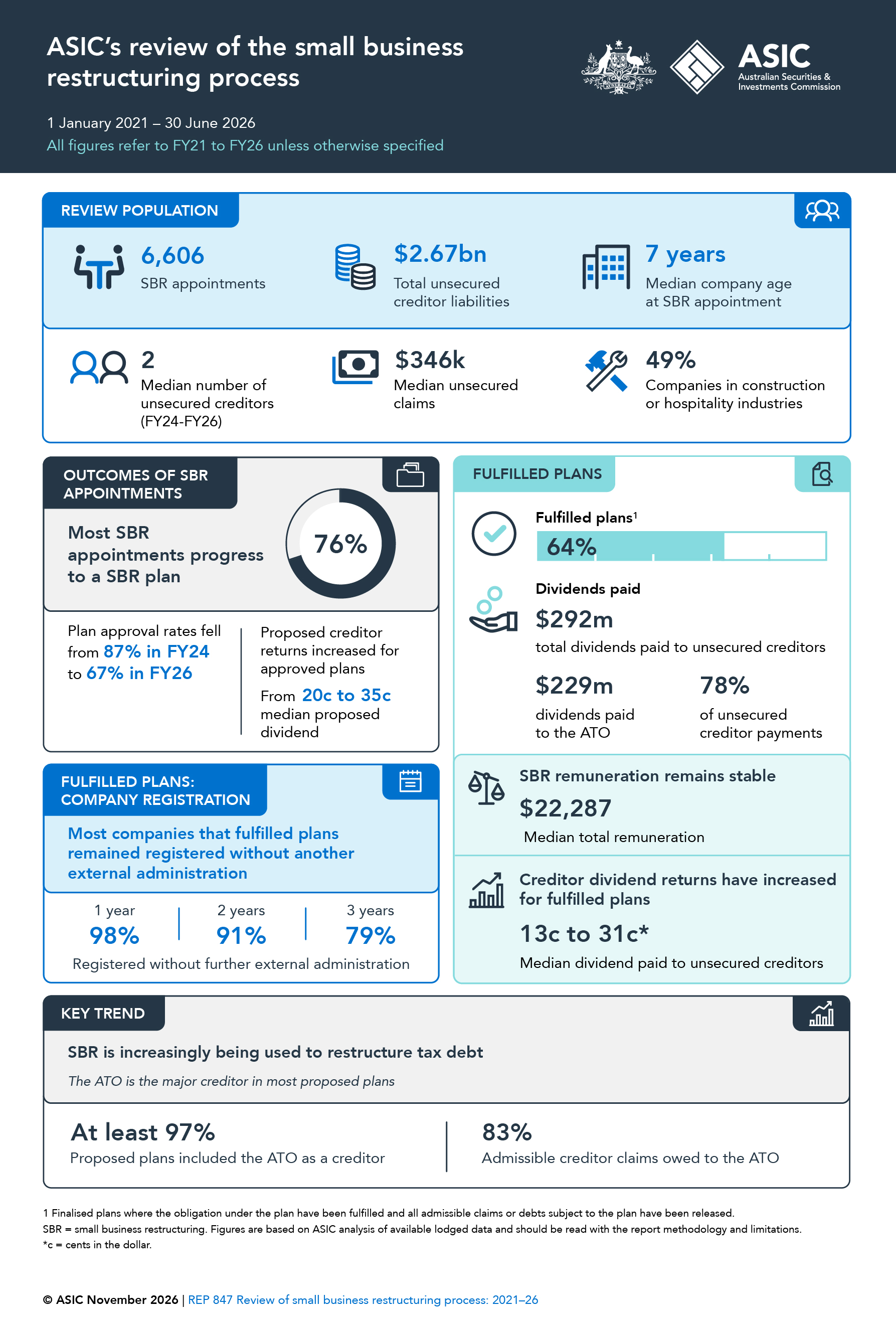
ASIC’s review of the small business restructuring process - text version
ASIC’s review of the small business restructuring process
1 January 2021 – 30 June 2026 All figures refer to FY21 to FY26 unless otherwise specified
REVIEW POPULATION
- 6,606 SBR appointments
- $2.67bn Total unsecured creditor liabilities
- 7 years Median company age at SBR appointment
- 2 Median number of unsecured creditors (FY24-FY26)
- $346k Median unsecured claims
- 49% Companies in construction or hospitality industries
OUTCOMES OF SBR APPOINTMENTS
Most SBR appointments progress to a SBR plan
- Plan approval rates fell from 87% in FY24 to 67% in FY26
- 76% progressed to a SBR plan appointment
- Proposed creditor returns increased for approved plans
- From 20c to 35cmedian proposed dividend
FULFILLED PLANS: COMPANY REGISTRATION
Most companies that fulfilled plans remained registered without another external administration
Registered without further external administration
- 1 year 98%
- 2 years 91%
- 3 years 79%
FULFILLED PLANS
- Fulfilled plans¹: 64%
Dividends paid
- $292m total dividends paid to unsecured creditors
- $229m dividends paid to the ATO
- 78% of unsecured creditor payments
SBR remuneration remains stable
- $22,287 Median total remuneration
Creditor dividend returns have increased for fulfilled plans
- 13c to 31c* Median dividend paid to unsecured creditors
KEY TREND
SBR is increasingly being used to restructure tax debt
The ATO is the major creditor in most proposed plans
- At least 97% Proposed plans included the ATO as a creditor
- 83% Admissible creditor claims owed to the ATO
1 Finalised plans where the obligation under the plan have been fulfilled and all admissible claims or debts subject to the plan have been released.
SBR = small business restructuring. Figures are based on ASIC analysis of available lodged data and should be read with the report methodology and limitations.
*c = cents in the dollar.
Download
- Report 847 Review of small business restructuring process: 2021–26 (REP 847)
- Report 847 Review of small business restructuring process: 2021–26 – Data pack
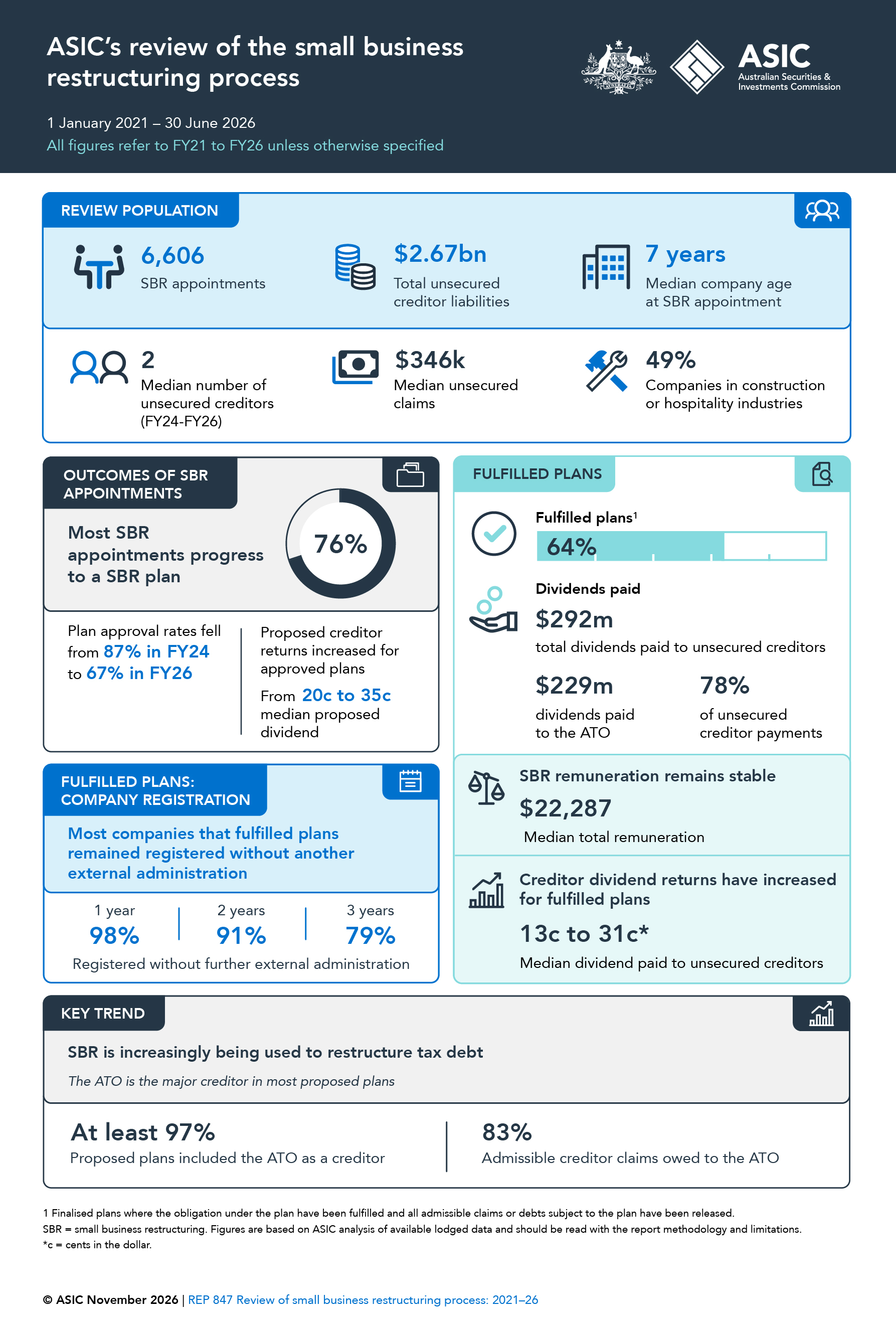
- REP 847 infographic: Review of small business restructuring process: 2021–26
Background
This review forms part of ASIC’s ongoing work to make available high-quality and granular data on insolvency and insolvency processes and follows ASIC’s Report 810 Review of small business restructuring process: 2022-2024 (REP 810) and Report 756 Review of small business restructuring process (REP 756).
The report also builds on ASIC’s previous work to provide greater insight into how Australia’s insolvency system is working, including our 2024 review of simplified liquidations (24-175MR), our 2026 review of the voluntary administration and deed of company arrangement process (26-144MR) and our 2026 review of court and creditors’ voluntary liquidation processes (26-258MR).