The Financial advice update is a round-up of regulatory developments and issues affecting financial advice.
It covers all areas of financial advice regulation and includes a broad range of content relevant to Australian financial services (AFS) licensees who are advice licensees and financial advisers.
ASIC guidance released for professional year candidates
ASIC has recently released new guidance to help professional year candidates, their supervisors and licensees to understand and meet their obligations during the professional year.
Information Sheet 297 FAQs: Professional Year (INFO 297) answers common questions about the professional year requirements, including record keeping, plans, tasks and logbooks. We have also provided candidates with a snapshot of some key milestones that must be met during the professional year.
The professional year is a supervised work and training period that forms part of the professional standards framework for relevant providers. The phased approach during the professional year is intended to support the transition to providing personal advice to retail clients as a fully qualified relevant provider.
Licensee selection
A person embarking on their professional year should select a licensee who:
- can ensure that they will be appropriately supervised
- will make appropriate resources and opportunities available to them and their supervisor to enable successful completion of the professional year, and
- will work with them and their supervisor to develop and agree on a written professional year plan and take reasonable steps to facilitate their completion of the professional year in accordance with the plan.
Supervisor selection
Individuals who are commencing the professional year should choose a supervisor who:
- has at least two years’ experience working as a relevant provider, excluding any period during which the supervisor was completing their own professional year (once the professional year candidate is authorised as a provisional relevant provider, their supervisor should also be a relevant provider but not a provisional relevant provider or a limited-service time-share adviser)
- can ensure that they are appropriately supervised, and
- will work with them and their responsible licensee to develop and agree on a written professional year plan and take reasonable steps to facilitate their completion of the professional year in accordance with the plan.
We remind professional year candidates, their supervisors and licensees that they must comply with specific record-keeping obligations during the professional year under the Corporations (Work and Training Professional Year Standard) Determination 2018. This includes the requirement for professional year candidates to complete and maintain logbooks with certain particulars.
Reference Checking Reminder
Recent breach reporting data indicates that AFS licensees are appointing advisers without completing reference checks. An AFS licensee must take reasonable steps to obtain a reference from a referee licensee before they employ or authorise a prospective representative.
ASIC's reference checking and information sharing protocol (ASIC Protocol) commenced on 1 October 2021. The transitional period ended on 1 March 2025 after which all references must be requested under the ASIC Protocol. To help AFS licensees comply with the ASIC Protocol, ASIC prepared Information Sheet 257 ASIC reference checking and information sharing protocol (INFO 257).
A civil penalty applies for non-compliance with the ASIC Protocol. ASIC may also take administrative action for non-compliance, which could include suspending or cancelling a licensee’s licence or imposing additional licence conditions.
In this context, the ASIC Protocol applies to:
- a ‘recruiting licensee’ – that is, a licensee that is considering employing or authorising a prospective representative as a financial adviser, and
- a ‘referee licensee’ – that is, an individual’s current licensee(s), former licensee(s) in the past five years, from whom a reference is sought.
The ASIC Protocol includes specific obligations for AFS licensees to undertake reference checks and share information on individuals seeking to be employed or authorised as a financial adviser or mortgage broker.
In addition to reference checks, AFS licensees should also give specific consideration to the monitoring and supervision arrangements of authorised representatives that have moved from AFS licensees with known compliance concerns – noting that there are a number of publicly known AFS licensees with recent compliance concerns highlighted by ASIC actions.
This is in accordance with an AFS licensee's responsibility to take reasonable steps to ensure their representatives comply with the financial services laws.
Surveillance of financial advice licensees reporting low professional indemnity insurance
In 2025, ASIC commenced the annual collection of data from AFS licensees about their professional indemnity (PI) insurance, through financial statements lodged with ASIC. The new form FS70, submitted through the Regulatory Portal, requires licensees to report the PI insurance they hold, the policy excess, and whether they have had a claim paid.
Our analysis of the submissions data identified 10 licensees that:
- were licensed for personal advice to retail clients on Tier 1 financial products
- had one or more financial advisers on the Financial Advisers Register (FAR), and
- stated to ASIC they have less than $2 million of PI insurance.
Regulatory Guide 126 Compensation and insurance arrangements for AFS licensees (RG 126) states that, to be adequate, a PI insurance policy must have a limit of at least $2 million for any one claim and in the aggregate for AFS licensees with total revenue from financial services provided to retail clients of $2 million or less. For AFS licensees with total revenue from financial services provided to retail clients greater than $2 million, minimum cover should be approximately equal to actual or expected revenue from financial services provided to retail clients (up to a maximum limit of $20 million).
After identifying potential gaps, we made enquiries of the 10 licensees to determine if regulatory action was needed. We found that in nine out of 10 cases, the licensees had made reporting errors in their FS70s lodgements, understating the insurance they held. These nine licensees provided evidence of their cover and resubmitted correct data through the Regulatory Portal.
However, in the remaining case the licensee misunderstood its obligations and held an inadequate insurance policy. Following ASIC’s intervention, the licensee lodged a reportable situation (breach report) and commenced the process to wind up the licensee by submitting an AFS licence cancellation application for ASIC’s assessment.
PI insurance is an essential component of the compensation framework. It is designed to protect the insured (i.e. the AFS licensee or credit licensee) against the risk of financial losses arising from poor quality services and other misconduct by a financial services provider (e.g. fraud by its representatives).
Our key messages to licensees are:
- Make sure you have an adequate PI insurance for your business. RG 126 (at Table 4) sets out ASIC’s view on the features an ‘adequate’ PI insurance policy. This includes what we consider are the minimum requirements for these features, and some factors you should consider when determining what is adequate depending on your business and individual circumstances.
- Take care to lodge your annual financial statements, including PI insurance data, accurately and on time.
Superannuation contribution and rollover advice: getting it right
ASIC continues to see poor quality personal advice about superannuation contributions and rollovers causing client harm. Recent Financial Services and Credit Panel (FSCP) outcomes show the need for advisers to exercise care where advice may affect a client’s contribution caps, transfer balance cap, tax position or retirement savings.
This advice is often complex and depends on the client’s circumstances. Errors, unsupported assumptions or inadequate inquiries can result in excess contributions, transfer balance cap breaches or avoidable tax. ASIC expects advisers to obtain and verify the information needed to provide compliant personal advice.
What ASIC is seeing
In the 2025-26 financial year, ASIC convened multiple FSCP sitting panels in response to poor superannuation advice involving contributions and rollovers. In these matters, clients exceeded contribution or transfer balance caps and incurred additional tax. In one matter, a panel reprimanded an adviser who failed to verify whether a client had previously commenced an account-based pension, finding that this conduct breached the Financial Planners and Advisers Code of Ethics 2019 value of Diligence.
ASIC also continues to observe issues arising where advisers:
- fail to verify existing superannuation arrangements
- overlook prior contributions, pensions or transfers
- recommend strategies without considering the client’s overall circumstances, and/or
- inadequately document the basis for advice.
Reminders for advisers
Before recommending a contribution strategy, rollover or pension commencement, advisers should obtain and verify information about:
- existing superannuation accounts and balances
- prior concessional and non-concessional contributions
- available cap space and transfer balance caps, and/or
- tax consequences, access conditions and insurance implications.
Records should clearly show the inquiries made, information relied on and reasons why the advice is appropriate.
Expectations of AFS licensees
AFS licensees should ensure representatives are trained on contribution caps, transfer balance cap issues and rollover advice. They should also supervise advice quality, identify deficiencies and remediate affected clients where non-compliant advice is detected.
ASIC's focus
Unsuitable superannuation advice remains a regulatory concern. ASIC will continue to review poor advice identified through reportable situations, surveillances and other intelligence sources and may take regulatory or administrative action, including referral of advisers to the FSCP.
Further reading
Financial advice update – February 2026
Qualifications standard for relevant providers
On 2 July 2026 ASIC announced the outcome of a review of records on the Financial Advisers Register (FAR) relating to compliance with the qualifications standard that took effect on 1 January 2026.
ASIC’s review commenced in late February 2026 and focussed on financial advisers (relevant providers) who did not have any qualifications or training courses marked as going toward meeting the qualifications standard.
For more information on what ASIC’s review found please see our news item: ASIC issues update on compliance with the financial adviser qualifications standard | ASIC
ASIC may undertake a further review looking at the details of the qualifications and training courses that AFS licensees have marked on the FAR as going toward meeting the qualifications standard for their relevant provider(s).
In addition to ASIC’s February review ASIC has been monitoring notifications in relation to relevant providers who have given their AFS licensee a declaration stating that they meet the definition of an experienced provider.
ASIC reminds AFS licensees to confirm that the relevant provider meets the definition of an experienced provider before they notify ASIC of a relevant provider’s declaration. For information on eligibility to access the experienced provider pathway please see ASIC’s Information Sheet 281 and in particular frequently asked question 1.
Qualification assessments – using ASIC’s worked examples
ASIC is aware that some AFS licensees may be relying on ASIC’s worked examples as a substitute for conducting their own assessment of a relevant provider’s qualifications. In some cases, AFS licensees may also be applying a worked example where the individual’s qualification does not match the example.
The worked examples are based on fictitious scenarios. They are intended to illustrate the steps an AFS licensee should take when assessing an individual’s qualifications against the Determination. They should not be used as a proxy for an AFS licensee’s own assessment.
ASIC has updated the wording in worked examples 1 and 2 by removing the reference to ‘The requirement to complete an Ethics for Professional Advisers bridging unit for a post-graduate degree is specified in section 6(3) of Part 2 of the Determination. If a masters degree is awarded by a higher education provider listed in Schedule 1 to the Determination, an Ethics for Professional Advisers bridging unit is not required’ because for some masters degrees it is required.
It is important that AFS licensees conduct their own assessment of a relevant providers qualifications against the Determination. There are no worked examples for post-graduate degrees and AFS licensees will need to use the Determination to assess the qualifications. To assist AFS licensees when assessing a post-graduate degree against the Determination ASIC will also update the webpage (Assessing relevant provider qualifications) to include a new step by step guide.
Relevant provider registration
Relevant providers (excluding provisional relevant providers but including time-share advisers) are reminded that, they must be registered before providing personal advice to retail clients in relation to relevant financial products.
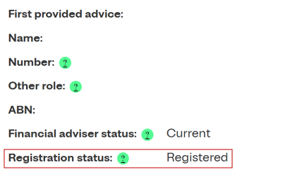
Relevant providers should be aware that registration is an ongoing obligation and is separate to being listed on the Financial Advisers Register as ‘current’ (see Figure 1).
Common circumstances that can result in a relevant provider becoming unregistered include:
- The relevant provider changes AFS licensee and the new AFS licensee does not register the relevant provider with ASIC.
- The relevant provider’s role changes from a provisional relevant provider to relevant provider, but the AFS licensee does not register the relevant provider with ASIC.
- The relevant provider is dual authorised and the registering AFS licensee ceases the relevant provider’s authorisation, causing the relevant provider’s registration to also cease. The remaining authorising AFS licensee then does not register the relevant provider with ASIC.
- The relevant provider’s authorisation ceased by operation for law (e.g., existing providers who failed to meet the qualifications standard on 1 January 2026) and the relevant provider is subsequently reappointed without also being registered with ASIC.
Consequences of giving advice while unregistered
A relevant provider who provides personal advice while unregistered will be in breach of a restricted civil penalty provision and may be subject to enforcement action. Relevant providers should confirm that they are registered with ASIC before providing personal advice.
An AFS licensee that authorises a relevant provider who provides advice while unregistered will have committed an offence of strict liability and contravened a civil penalty provision.
Checking your registration status on the Financial Advisers Register
Relevant providers can check their registration status on the Financial Advisers Register (FAR) in real time. If the relevant provider is registered, their registration status will appear as shown in Figure 1:
Figure 1: A sample FAR entry showing adviser status as ‘registered’
ASIC has released webinars, guidance documents and communications to assist relevant providers and AFS licensees in meeting their obligations. For more information see Registering a relevant provider with ASIC.
Summary of recent ASIC enforcement matters
|
Date |
Enforcement action |
|
26 February 2026 |
ASIC announced that it has cancelled the Australian financial services licence of Private Wealth Pty Ltd following two payments made by the Compensation Scheme of Last Resort (CSLR) in relation to unpaid Australian Financial Complaints Authority (AFCA) determinations. Private Wealth failed to pay compensation awarded by AFCA, resulting in CSLR payments totalling more than $115,000. ASIC is required to cancel an AFS licence where a licensee fails to pay an AFCA determination and compensation is subsequently paid by the CSLR. See Media Release (26-035MR) ASIC cancels AFS licence of Private Wealth Pty Ltd (26 February 2026). |
|
9 March 2026 |
ASIC announced that Brisbane financial adviser, accountant, registered tax practitioner and self-managed superannuation fund auditor Sunny Mahendra Prakash has been charged with multiple dishonesty offences following an ASIC investigation. ASIC alleges that between 2016 and 2024, Mr Prakash provided unlicensed financial services, executed unauthorised share trades, falsified a fixed-term deposit certificate, and misappropriated approximately $4.9 million from client accounts, causing a further $1,277,776.94 million in trading losses. See Media Release (26-042MR) Brisbane financial advisor and auditor, Sunny Prakash, charged with multiple counts of stealing and fraud (9 March 2026). |
|
9 March 2026 |
ASIC announced that it has banned former credit and financial services representative Neil Andrew Cato from involvement in the financial services and credit industries for five years. ASIC found that Mr Cato had been linked to the refusal or failure to comply with two Australian Financial Complaints Authority (AFCA) determinations and had become insolvent in February 2024. The banning order prohibits Mr Cato from providing financial services, engaging in credit activities, performing related functions, or controlling entities that carry on financial services or credit businesses until 27 February 2031. See Media Release (26-043MR) ASIC bans former credit and financial services representative Neil Andrew Cato for five years (9 March 2026). |
|
10 March 2026 |
ASIC announced that it has banned former MWL Financial Services adviser Raluca Terheci from providing financial services for six years. ASIC found that Ms Terheci provided inappropriate advice that was not in clients’ best interests by recommending that clients invest most of their superannuation into high-risk investment options within the Shield Master Fund. ASIC also found that Ms Terheci’s statements of advice contained false and misleading statements regarding Shield’s performance history and expected returns. ASIC determined that Ms Terheci was not fit and proper, was not adequately trained or competent, and was likely to contravene a financial services law. See Media Release (26-044MR) ASIC bans former MWL Financial Services Adviser Raluca Terheci for a period of six years (10 March 2026). |
|
2 April 2026 |
ASIC announced that it has cancelled the Australian financial services licence of Beacon Wealth Pty Ltd after finding that the company had ceased carrying on a financial services business and had not taken the necessary steps to recommence operations. ASIC found that Beacon Wealth had not operated a financial services business since at least June 2024 and had failed to progress a proposed licence variation, provide required information to ASIC, or pay applicable fees. ASIC determined that any proposed acquisition of the licence would have constituted the commencement of a new financial services business rather than the continuation of an existing one. See Media Release (26-060MR) ASIC cancels AFS licence of Beacon Wealth Pty Ltd (2 April 2026). |
|
7 April 2026 |
ASIC announced that it has banned former MWL Financial Services adviser David Lofthouse from providing financial services for three years. ASIC found that Mr Lofthouse provided inappropriate advice that was not in clients’ best interests by recommending that six clients invest at least 75% of their superannuation savings into high-risk investment options within the Shield Master Fund. ASIC noted that the Shield Master Fund had no meaningful performance track record, was not intended to be a complete investment program and was affected by governance conflicts of interest. See Media Release (26-062MR) ASIC bans former MWL financial services adviser David Lofthouse for three years (7 April 2026). |
|
9 April 2026 |
ASIC announced that it has permanently banned former financial adviser and credit representative Aristotle Papapavlou from involvement in the financial services and credit industries. ASIC found that Mr Papapavlou engaged in dishonest, misleading and unprofessional conduct, including participating in a high-volume advice model that resulted in clients being advised to invest in Shield and First Guardian, using unlicensed third-party referrers, and prioritising remuneration over clients’ best interests. ASIC also found that Mr Papapavlou engaged in dishonest and deceptive conduct in the credit industry and was not a fit and proper person to provide financial services or engage in credit activities. See Media Release (26-067MR) ASIC permanently bans former financial adviser and credit representative Aristotle Papapavlou (9 April 2026). |
|
10 April 2026 |
ASIC announced that it has permanently banned Yanhua (Scott) Chen from the financial services industry. ASIC found that Mr Chen was not a fit and proper person and lacked the judgement and character required to operate in the financial services sector. ASIC's decision followed findings that Mr Chen received $490,000 from a client to invest in certain stocks but instead used the funds for trading on his own account, resulting in losses, while misleading the client into believing the funds had not been lost. See Media Release (26-070MR) ASIC permanently bans Yanhua Chen from the financial services industry (10 April 2026). |
|
10 April 2026 |
ASIC announced that it has banned former financial adviser Shane Monte Silva from the financial services industry for five years after finding that he failed to act in certain clients’ best interests when recommending they switch their superannuation to invest in high-risk products, including the Shield Master Fund and First Guardian Master Fund. ASIC found that Mr Monte Silva participated in an advice process involving misleading Statements of Advice, unlicensed third-party referrers, and recommendations for clients to invest all of their superannuation savings into one or more high-risk investments. ASIC concluded that the advice process failed to meet the standards expected of an experienced financial adviser. See Media Release (26-072MR) Shane Monte Silva banned for five years over flawed Shield and First Guardian advice (10 April 2026). |
|
10 April 2026 |
ASIC announced that it has banned former financial adviser Rhys James Rolls Reilly from providing financial services for 10 years and suspended the Australian financial services licence of Conexus Group Pty Ltd until 31 July 2026. ASIC found that Mr Reilly engaged in serious misconduct, including accepting conflicted remuneration, making false or misleading statements to clients, failing to act in clients’ best interests, and recommending that clients invest most or all of their superannuation into the First Guardian Master Fund without adequately assessing suitability or risk. ASIC also suspended Conexus’s licence because Mr Reilly was the sole director and person in control of the licensee, and ASIC considered that the company was likely to contravene its licence obligations while he remained in control. On 29 July 2026, ASIC cancelled Conexus’s AFS Licence. Conexus has lodged an application for a review of ASIC’s decision with the Administrative Review Tribunal See Media Release (26-073MR) ASIC bans former financial adviser Rhys Reilly for 10 years and suspends Conexus Group’s AFS licence (10 April 2026). |
|
23 April 2026 |
ASIC announced that it has banned former MWL financial adviser John Morgan from providing financial services for five years. ASIC found that Mr Morgan provided inappropriate advice that was not in clients’ best interests by recommending that clients invest most of their superannuation into various classes of the Shield Master Fund, including high-risk and medium-risk investment options. ASIC also found that Mr Morgan’s Statements of Advice contained false and misleading statements regarding Shield’s performance history and implied clients would achieve superior investment returns despite the fund only commencing in May 2021. See Media Release (26-079MR) ASIC bans former MWL financial adviser John Morgan for five years (23 April 2026). |
|
24 April 2026 |
ASIC announced that it is continuing its crackdown on unlawful financial influencers (finfluencers) alongside 16 international regulators. ASIC issued warning notices to four finfluencers suspected of providing unlicensed financial advice or engaging in misleading conduct and commenced reviews of several AFS licensees overseeing 15 finfluencers operating under their licences. The action forms part of a global initiative aimed at disrupting unlawful online financial promotion and protecting consumers from misleading financial information on social media. See Media Release (26-081MR) ASIC continues finfluencer crackdown alongside global regulators (24 April 2026). |
|
8 May 2026 |
ASIC announced that it has permanently banned Queensland property developer Trent Simon Giumelli from providing financial services. ASIC found that Mr Giumelli operated unregistered managed investment schemes and carried on a financial services business without an Australian financial services licence for approximately eight years, raising around $48 million from members of the public across 27 property development projects. ASIC concluded that Mr Giumelli demonstrated serious incompetence and irresponsibility, disregarded financial services laws, and was likely to contravene those laws in the future. See Media Release (26-093MR) ASIC permanently bans Queensland property developer Trent Giumelli from financial services (8 May 2026). |
|
12 May 2026 |
ASIC announced that the Administrative Review Tribunal (ART) increased a registration prohibition against former UGC financial adviser Stephen Rogers from two years to three years following a review of the Financial Services and Credit Panel’s (FSCP) original decision. The FSCP had found that Mr Rogers provided non-compliant advice and engaged in misleading or deceptive conduct, including using a scaled advice model that failed to adequately consider the suitability of establishing a self-managed superannuation fund and investing in products linked to his licensee. ASIC presented evidence of similar breaches in additional UGC client files, resulting in the ART imposing a longer prohibition period. See Media Release (26-095MR) Registration prohibition order against former UGC financial adviser Stephen Rogers increased to three years following review (12 May 2026). |
|
9 June 2026 |
ASIC announced that it has permanently banned former Brite Advisors responsible manager Gerard Duffy from providing financial services. ASIC found that Mr Duffy was not a fit and proper person after failing to disclose and manage actual, perceived or potential conflicts of interest and providing responses to ASIC examinations that indicated a lack of integrity and honesty. ASIC also found that Mr Duffy failed to disclose his employment with the Australian Financial Complaints Authority (AFCA) to ASIC and failed to disclose his relationship with Brite to AFCA, leading ASIC to conclude that he lacked the honesty, integrity and sound judgement required to operate in the financial services industry. See Media Release (26-115MR) ASIC permanently bans former responsible manager Gerard Duffy from providing financial services (9 June 2026). |
|
15 June 2026 |
ASIC announced that it has permanently banned Abdullah Popal from engaging in financial services and credit activities following fraud convictions. Mr Popal was convicted of two counts of dishonestly obtaining a financial advantage by deception after transferring $89,932 from former clients’ bank accounts into accounts held in his own name. ASIC determined that the fraud convictions warranted a permanent ban from providing financial services, engaging in credit activities, controlling relevant businesses, or performing functions within those industries. See Media Release (26-120MR) ASIC permanently bans Abdullah Popal from financial services and credit (15 June 2026). |
|
19 June 2026 |
ASIC announced that it has banned financial adviser Brett Anthony Newbound from providing financial services and engaging in credit activities for 10 years, and cancelled the Australian financial services and Australian credit licences of Freedom Wealth Services Pty Ltd. ASIC found that Mr Newbound relied on service agreements containing client signatures that had not been provided by the clients and created, or caused to be created, file notes that did not accurately reflect client interactions in order to justify charging ongoing service fees. ASIC determined that this conduct meant Mr Newbound was not a fit and proper person to participate in the financial services and credit industries. See Media Release (26-128MR) ASIC bans Brett Anthony Newbound from providing financial services for 10 years and cancels licenses of Freedom Wealth Services Pty Ltd (19 June 2026). |
|
26 June 2026 |
ASIC announced that it has commenced Federal Court proceedings against former Keystone Asset Management directors Paul Chiodo, Ilya Frolov and Mark Yorston, and former compliance committee members Jeremy Danon and Ilya Frolov, over alleged failures relating to the Shield Master Fund. ASIC alleges that hundreds of millions of dollars of investor superannuation were transferred to related entities and third parties without appropriate safeguards, oversight, valuations or management of conflicts of interest. ASIC further alleges that more than $530 million from approximately 5,800 investors was invested in the Shield Master Fund, with around $305 million transferred to related entities in circumstances that exposed investors to significant financial risk. See Media Release (26-133MR) ASIC sues former Keystone Asset Management directors and compliance committee members over alleged Shield failures (26 June 2026). |
|
15 July 2026 |
ASIC announced that it has banned former MWL Financial Services adviser Nicole Niu from providing financial services for five years. ASIC found that Ms Niu provided inappropriate advice that was not in clients’ best interests by recommending that clients invest most of their superannuation into the High Growth, Growth and Balanced classes of the Shield Master Fund, despite the fund having a limited trading history and containing high or medium-risk investment options. ASIC also found that Ms Niu’s Statements of Advice contained false and misleading statements regarding Shield’s historical performance and implied that clients would achieve superior returns, despite Shield only commencing in May 2021. ASIC determined that Ms Niu was likely to contravene a financial services law. The banning order took effect from 22 January 2026. See Media Release (26-155MR) ASIC bans former MWL financial adviser Nicole Niu for five years (15 July 2026). |
|
17 July 2026 |
ASIC announced that former MWL Financial Services adviser Christian Henry has been banned from providing personal financial advice and participating in the financial services industry for three years. ASIC had originally imposed a five-year ban after finding that Mr Henry provided inappropriate advice that was not in clients’ best interests, including recommending that clients invest most of their superannuation into high-risk classes of the Shield Master Fund. Following a review by the Administrative Review Tribunal, the ban was reduced to three years by agreement. See Media Release (26-158MR) Former MWL financial adviser Christian Henry banned for three years (17 July 2026). |
|
17 July 2026 |
ASIC announced that it has cancelled the Australian financial services licence of Australian Fiduciaries Limited (In Liquidation) following a $150,000 payment made by the Compensation Scheme of Last Resort (CSLR) in respect of an unpaid Australian Financial Complaints Authority (AFCA) determination. ASIC is required to cancel the licence of a financial services provider that fails to satisfy an AFCA determination where the CSLR subsequently pays compensation. ASIC also directed Australian Fiduciaries to maintain its AFCA membership until 19 June 2027 so that eligible complaints can continue to be lodged. See Media Release (26-159MR) ASIC cancels AFS licence of Australian Fiduciaries Limited (In Liquidation) (17 July 2026). |
|
24 July 2026 |
ASIC announced that it has banned former NextGen Financial Group Pty Ltd directors Nicholas Brookes and Vitorio Turco from providing financial services for three years. ASIC found misconduct relating to their involvement in the operation and management of the financial services business and determined they were not fit and proper persons to participate in the financial services industry. The banning orders prohibit them from providing financial services, performing functions in a financial services business, or controlling a financial services business for three years. See Media Release (26‑168MR) ASIC bans former NextGen Financial Group Pty Ltd directors Nicholas Brookes and Vitorio Turco for three years) (24 July 2026). |
|
10 August 2026 |
ASIC announced that it has suspended the Australian financial services licence of Central Accord Pty Ltd for six months until 4 February 2027. ASIC suspended the licence after finding that Central Accord was no longer carrying on a financial services business. ASIC noted that the company had come to its attention after being expelled from membership of the Australian Financial Complaints Authority for failing to pay invoices that were more than 12 months overdue. The suspension took effect on 30 July 2026. See Media Release (26‑186MR) ASIC suspends AFS licence of Central Accord Pty Ltd for six months) (10 August 2026). |
Update from the Financial Services and Credit Panel
The Financial Services and Credit Panel (FSCP) makes disciplinary decisions in relation to financial advisers. The FSCP is a pool of industry participants, appointed by the responsible Minister, that ASIC draws on when forming individual sitting panels.
The FSCP operates alongside but independent of ASIC’s existing administrative decision-making processes.
ASIC maintains the FSCP Outcomes Register which contains decisions of the FSCP and a brief explanation of the background to the decisions. Some recent outcomes include:
- A written direction issued to a relevant provider for contraventions of sections 961B(1), 961G and 921E(3) of the Corporations Act – Inappropriate SMSF and investment advice – The sitting panel found that the relevant provider advised a client in February 2024 to establish a self-managed superannuation fund (SMSF), roll over existing superannuation benefits into the SMSF, make non-concessional contributions and invest in certain unregistered managed investment schemes available only to wholesale investors. The sitting panel believed that the relevant provider failed to comply with the best interests duty and appropriate advice obligation because the advice did not recommend concessional contributions that were available to the client, the recommended wholesale investments were not appropriate having regard to the client’s circumstances, and the SMSF structure was not suitable given the client’s circumstances and the higher costs associated with operating an SMSF. The sitting panel also reasonably believed that the relevant provider contravened section 921E(3) of the Corporations Act 2001 by failing to comply with Code of Ethics Standard 5, which requires advisers to act with diligence and provide advice that is fit for purpose. A written direction requiring specified supervision was issued (26 February 2026).
- A registration prohibition order issued for contraventions of sections 946A(1), 946C(1), 961B(1), 961G, 1041E and 921E(3) of the Corporations Act – The sitting panel found that Peter Morrison‑Dowd contravened multiple financial services laws by giving misleading advice, making misleading statements regarding investment returns, failing to provide required Statements of Advice and failing to act in clients’ best interests. The Panel made a registration prohibition order under sections 921L(1)(c) and 921L(1)(d) of the Corporations Act, cancelling all of Mr Morrison‑Dowd’s registrations as a relevant provider and prohibiting him from being registered again until after 13 September 2027. The registration cancellation took effect on 10 July 2026, being the date the decision was served. The panel also found breaches of Code of Ethics Standards 2, 5 and 9 (4 March 2026).
- A reprimand issued to a relevant provider for contraventions of sections 961B(1), 961G and 921E(3) of the Corporations Act – Inappropriate insurance and superannuation advice – The sitting panel determined that the relevant provider contravened the best interests duty and appropriate advice obligation in relation to advice provided to two retail clients between February 2023 and April 2024. In the first matter, the relevant provider failed to make reasonable inquiries to obtain complete and accurate information about whether the client held insurance through their existing superannuation fund before recommending that the client transfer their superannuation to another fund. In the second matter, the relevant provider failed to base their advice on the clients’ relevant circumstances, with numerous errors and inconsistencies recorded in the Statement of Advice, including incorrect information about the client’s existing superannuation arrangements, employment status and insurance holdings. The sitting panel also reasonably believed that the relevant provider contravened section 921E(3) of the Corporations Act 2001 by failing to demonstrate the Code of Ethics values of competence and diligence and breaching Standards 5 and 9. A reprimand was issued (9 March 2026).
- A reprimand issued to a relevant provider for contraventions of sections 961B(1), 961G, 947D and 921E(3) of the Corporations Act – Superannuation rollover resulting in loss of insurance – The sitting panel found that the relevant provider advised two clients in August 2023 to roll over their superannuation balances to a new superannuation plan but failed to identify that death and Total and Permanent Disability (TPD) insurance was held through their existing superannuation funds. As a result of the rollover recommendations, the clients lost their death and TPD insurance cover. The error remained undetected despite the relevant provider subsequently providing two Records of Advice and was only identified in August 2024. Following discovery of the issue, the relevant provider notified the licensee and arranged for the clients to undergo an insurance review. The sitting panel reasonably believed that the relevant provider contravened the best interests duty, appropriate advice obligation and Statement of Advice requirements under sections 961B(1), 961G and 947D of the Corporations Act 2001. The panel also found that the relevant provider contravened section 921E(3) by failing to comply with Code of Ethics Standards 5 and 9, relating to client care and the maintenance of a quality advice process. A reprimand was issued (18 March 2026).
- A reprimand issued to a relevant provider for contravention of section 921E(3) of the Corporations Act – Fees for no service – The sitting panel found that the relevant provider charged ongoing financial advice fees to clients but failed to provide the services for which those fees were charged. The sitting panel reasonably believed that the relevant provider contravened section 921E(3) of the Corporations Act 2001 by failing to comply with the Code of Ethics, specifically the values of trustworthiness and diligence, and breaching Standards 2 and 7. In determining the appropriate outcome, the panel was satisfied that the conduct involved a single instance of fees-for-no-service arising from human error and that the relevant provider had taken appropriate remedial steps to prevent similar misconduct occurring in the future. A reprimand was issued (8 April 2026).
- No action taken in relation to an alleged fees-for-no-service matter – The sitting panel considered concerns that the relevant provider had contravened section 921E(3) of the Corporations Act 2001 by charging two clients, a husband and wife, ongoing monthly advice fees without providing the services for which those fees were paid. After considering submissions from the relevant provider and the circumstances of the matter, the sitting panel determined that disciplinary action was not warranted and decided not to take any action against the relevant provider (14 April 2026).
- A written direction issued to a relevant provider for contravention of section 921E(3) of the Corporations Act – Fees for no service – The sitting panel found that the relevant provider charged a client ongoing financial advice fees without providing all of the services for which those fees were charged. The client continued to be charged after the services agreement had expired, resulting in ongoing fees being deducted without a valid agreement in place. The sitting panel reasonably believed that the relevant provider contravened section 921E(3) of the Corporations Act 2001 by failing to comply with the Code of Ethics, specifically the values of trustworthiness and diligence, and breaching Standards 2 and 7. In determining the appropriate outcome, the panel acknowledged that some ongoing services had been provided and that the relevant provider had made attempts to contact the client and deliver services contemplated under the agreement. The panel also accepted that the fees charged after the expiry of the agreement arose from an administrative error and were not deliberate. However, the panel considered that the relevant provider should have had adequate systems and governance arrangements in place to prevent and detect such errors, particularly as the client continued to be charged for a further 17 months until a complaint was made to the licensee. A written direction was issued (16 April 2026).
- A written direction issued to a relevant provider for contravention of section 921E(3) of the Corporations Act – Fees for no service – The sitting panel found that the relevant provider entered into ongoing fee arrangement agreements with four clients under which the clients agreed to pay fees in exchange for annual advice reviews to be conducted within each client’s 12‑month review period. Despite continuing to charge the agreed fees, the relevant provider failed to conduct the annual advice reviews within the required review periods. The sitting panel reasonably believed that the relevant provider contravened section 921E(3) of the Corporations Act 2001 by failing to comply with the Code of Ethics, specifically the values of trustworthiness and diligence, and breaching Standards 2 and 7. In determining the appropriate outcome, the panel noted that failing to provide annual advice reviews in a timely manner can have significant consequences for clients, including circumstances where important matters such as insurance arrangements are not reviewed and insurance policies may lapse. A written direction was issued (20 April 2026).
- A written direction issued to a relevant provider for contraventions of sections 961B(1), 961G and 921E(3) of the Corporations Act – Inappropriate insurance and superannuation advice – The sitting panel determined that the relevant provider contravened the best interests duty and appropriate advice obligation in relation to several pieces of superannuation and insurance advice provided to a retail client in 2024. The relevant provider failed to make reasonable inquiries about the client’s pre-existing medical condition and did not adequately investigate replacement insurance before recommending that existing insurance cover be replaced. The relevant provider also failed to investigate the client’s eligibility for the recommended insurance product and failed to base recommendations on the client’s relevant circumstances when advising on the transfer of insurance cover from one provider to another. The sitting panel reasonably believed that the relevant provider contravened sections 961B(1) and 961G of the Corporations Act 2001 and further contravened section 921E(3) by failing to comply with the Code of Ethics, including the values of competence and diligence, and breaching Standards 5, 8 and 9. A written direction requiring specified supervision was issued (10 June 2026).
- Fees-for-no-service and Code of Ethics breaches – The Sitting Panel found that the relevant provider charged ongoing financial advice fees to clients but failed to provide the services for which those fees were charged. The Panel reasonably believed that the provider contravened s921E(3) of the Corporations Act 2001 by failing to comply with the Financial Planners and Advisers Code of Ethics 2019, specifically the values of trustworthiness and diligence, and by breaching Standards 2, 7 and 8. Outcome: The Sitting Panel determined that the provider had failed to meet their ethical obligations in relation to the charging of ongoing advice fees and imposed disciplinary action (3 August 2026).
- No action taken in relation to advice resulting in a transfer balance cap breach – The matter was referred to the Sitting Panel following concerns that the relevant provider may have contravened ss961B(1), 961G and 921E(3) of the Corporations Act 2001 in relation to personal advice provided to a retail client which resulted in the client breaching their transfer balance cap. The Sitting Panel considered the available material and assessed the concerns regarding the provider's compliance with their best interests, appropriateness and ethical obligations. The sitting panel decided not to take any action against the relevant provider (6 August 2026).
- No action taken in relation to alleged contraventions of sections 961B(1), 961G and 921E(3) of the Corporations Act – Advice resulting in a transfer balance cap breach – The matter was referred to the sitting panel following concerns that the relevant provider contravened sections 961B(1), 961G and 921E(3) of the Corporations Act 2001 in relation to personal advice provided to a retail client that resulted in the client breaching their transfer balance cap. After considering the material before it, the sitting panel determined that no regulatory action was warranted and decided not to take any action against the relevant provider (6 August 2026).
For further information on the functions and operation of the FSCP, see Regulatory Guide 263 Financial Services and Credit Panel (RG 263).
Additional references – ASIC’s views
Step into your role in the system, joint keynote address by ASIC Commissioner Simone Constant at the Conexus Super Chair Forum, Sorrento on 4 February 2026
Protecting our superannuation system is everyone’s responsibility, keynote address by ASIC Commissioner Alan Kirkland at the Law Council of Australia’s Superannuation Lawyers Conference, Hobart on 26 March 2026.
The power of public accountability, keynote address by ASIC Chair Joe Longo at the 2026 Financial Counselling Australia Conference in Cairns on 7 May 2026.
ASIC Chair Sarah Court speaks at ABA Conference, fireside discussion, Chair Sarah Court with The Hon. Simon Birmingham, CEO of the Australian Banking Association (ABA), at the ABA conference, Melbourne on 17 June 2026.
Productivity is a team sport: ASIC’s contribution from in goals, keynote address by ASIC Commissioner Kate O’Rourke at the AFIA Risk Summit, Melbourne on 23 June 2026.
The best interests duty: A blueprint for building trust, speech by ASIC Commissioner Alan Kirkland at the Mortgage and Finance Association of Australia Conference, Melbourne on 22 July 2026.
Recent ASIC articles and reports on financial advice
ASIC trims regulatory guidance to reduce complexity for industry (10 March 2026)
Moneysmart refresh puts young Australians at the centre of trusted financial guidance (16 March 2026)
26-051MR ASIC launches financial complaints data dashboard (18 March 2026)
Moneysmart publishes tips on using AI for financial issues (23 March 2026)
ASIC updates relief instrument for generic financial calculators (26 March 2026)
ASIC updates financial reporting relief instruments (27 March 2026)
ASIC releases March 2026 financial adviser exam results (2 April 2026)
ASIC updates relief for securitisation entities from holding an AFS licence (10 April 2026)
ASIC proposes to remake relief from dollar disclosure and AFS licensing requirements (5 May 2026)
ASIC proposes to remake legislative instrument about client money held in cash common funds (5 May 2026)
Australians reminded to check for lost money as $2.7 billion sits unclaimed (15 May 2026)
26-100MR ASIC continues to ease regulatory burden (19 May 2026)
ASIC updates financial complaints data dashboard (3 June 2026)
Moneysmart reports strong demand for retirement planner (9 June 2026)
ASIC updates guidance on advertising financial products and services (9 June 2026)
Moneysmart encourages Australians to take 10 minutes to build a budget this new financial year (29 June 2026)
ASIC issues update on compliance with the financial adviser qualifications standard (2 July 2026)
ASIC releases June 2026 financial adviser exam results (3 July 2026)
ASIC releases estimated industry funding levies for 2025-26 (13 July 2026)
26-185MR ASIC protects consumers by removing high-risk financial sector participants (10 August 2026)
ASIC proposes to extend financial services, credit and markets legislative instruments (11 August 2026)
Subscribe to ASIC’s Newsroom
You can find all newsroom content tagged ‘financial advice’ using this pre- filtered newsroom link.
To receive relevant regulatory updates:
- go to ASIC’s Newsroom
- scroll down to ‘Sign up for news alerts’ and input your email address
- select your preference for receiving these alerts (weekly or daily)
- select ‘ASIC’s news round up’ and your preferred topics (we recommend selecting ‘financial advice’ and ‘regulatory updates’ to receive relevant updates), and
- click the subscribe button (this will override previous subscriptions).
Alternatively, select the ‘Review and update your subscription’ link in your subscription emails to update your preferred topics.
ASIC is Australia’s corporate, markets and financial services regulator.