
Corporate Finance Update – Issue 30 – August 2026
Issue 30 of the Corporate Finance Update covers regulatory developments and issues affecting corporate finance activity.
ASIC Chair outlines strategic priorities with focus on being easier to deal with and harder to avoid
ASIC Chair Sarah Court has set out ASIC’s priorities for the year ahead, outlining how the regulator will sharpen its focus on supporting growth and productivity by being more responsive, identifying and preventing harms earlier, and setting clear expectations backed by targeted action and stronger consequences.
Speaking at a Committee for Economic Development of Australia (CEDA) event in Sydney, Ms Court shared her perspective on the challenges and opportunities facing Australia’s financial system.
Ms Court emphasised that ASIC has a clear mandate from government to support growth and productivity and a responsibility to ensure our actions strengthen the economy.
To do so, the Chair outlined a vision of ASIC becoming easier to deal with for those who are doing the right thing and harder to avoid for those who are not.
Read Sarah Court's full address to CEDA.
ASIC paves the way for greater transparency of listed entity ownership and control
ASIC has simplified compliance with new enhanced beneficial ownership reforms that will improve transparency about who ultimately owns, controls or has significant economic exposure to listed entities in Australia.
ASIC consulted on draft technical settings earlier this year in Consultation Paper 387 Enhanced beneficial ownership disclosure: Proposed legislative instrument, form and guidance (CP 387) after the reforms, passed in December 2025, imposed enhanced substantial holding disclosure and beneficial ownership disclosure obligations on listed entities.
Among other changes, ASIC has:
- made the new Substantial Holding Notice (SHN) form, consolidating three forms into one
- simplified the calculation used to determine deemed economic interests and offsetting short positions in listed securities, by using the full notional amount of underlying securities, and
- implemented an index-based format for registers of relevant interests.
Before 4 June 2027, interest holders can meet their substantial holding obligations either by using the new SHN or one of three replacement forms that will take the place of Form 603, Form 604 and Form 605. These forms are available at our Substantial holding notice webpage.
ASIC has also published updated Regulatory Guide 5 Relevant interests and deemed economic interests (RG 5), Regulatory Guide 9 Takeover Bids (RG 9) and Regulatory Guide 222 Substantial holding disclosure and tracing requirements (RG 222).
ASIC is also exploring with market operators a web-based portal that could simplify future lodgement of substantial holding information.
For more information, see Summary of feedback to CP 387 and ASIC’s response.
ASIC proposes improved pre-IPO advertising flexibility and global alignment
ASIC invites feedback on Consultation Paper 390 Proposed reform to the pre-lodgement advertising and publicity regime (CP 390) to extend existing relief to allow companies greater flexibility to advertise and publicise upcoming initial public offerings (IPOs) before lodging a prospectus.
CP 390 responds to industry feedback received as part of ASIC’s discussion paper on Australia’s evolving capital markets, Report 823 Advancing Australia’s evolving capital markets: Discussion paper response report (REP 823), which commented that current IPO advertising and publicity rules do not reflect modern information-sharing practices.
ASIC’s changes aim to modernise and simplify the pre-lodgement advertising framework for IPOs by:
- bringing the rules in line with comparable international jurisdictions and other domestic fundraising regimes, such as crowd-sourced equity funding and offers made under a product disclosure statement
- allowing offerors to communicate in a controlled and accountable way
- helping companies gauge market interest, improve information quality and enabling timely clarification or corrections
- providing earlier regulatory visibility of potential offers and related market activity
- maintaining core investor safeguards by reinforcing the prospectus as the primary disclosure document for investment decisions.
Under the proposed rules, companies could advertise unquoted securities as long as they:
- identify the issuer and the seller of the security
- ensure a prospectus is made available by the time a security is listed
- make it clear where and when a prospectus will be made available
- direct investors to the disclosure document as the key source of information before making an investment decision.
Feedback on the proposal is due by 11 September 2026 and can be sent to markets.consultation@asic.gov.au.
ASIC’s measured approach to the SpaceX cross-border IPO
In the recent SpaceX offer, ASIC took a measured and pragmatic approach to assessing disclosures for Australian investors to directly participate in the cross-border initial public offering (IPO). The offer was novel in several respects, including its global scale and the likelihood that Australian retail investors would obtain indirect exposure through superannuation following the offer.
For this offer, our assessment of the disclosure documents focused on whether investors would receive clear, prominent and balanced information about the investment and its risks, rather than whether the disclosures would exactly replicate those required in Chapter 6D of the Corporations Act 2001 in a conventional Australian IPO.
The final disclosure package given to Australian investors comprised SpaceX’s US registration statement and a substantial, Australia-specific, supplement. The supplementary disclosure addressed Australia-specific risk factors, prospective financial information, governance arrangements and key differences between US and Australian market practices.
The SpaceX offer highlighted the importance of ensuring disclosure is tailored to the needs of Australian investors. While disclosure prepared for another jurisdiction may meet overseas requirements, Australian investors need clear and meaningful information about matters that may affect their investment decision, including key differences in governance arrangements, liability frameworks, market practices and investor rights.
ASIC encourages early engagement where an offer raises novel issues or involves structures that differ from established Australian market practice.
Consistent with our broader work to support strong, well-functioning public and private markets, the SpaceX offer demonstrates ASIC's willingness to engage constructively on innovative capital raising opportunities. Our dual focus is to balance support for capital formation while also ensuring investors receive the information they need to make informed investment decisions and participate in markets with confidence.
Growing pains: Scheme booklets surge to an average of 440 pages
ASIC is urging scheme proponents to apply the materiality test with greater rigour, to ensure that members are not provided with unnecessarily lengthy scheme booklets.
Between 2000 and July 2026, the average length of scheme booklets registered by ASIC has more than doubled, from 183 to 440 pages.
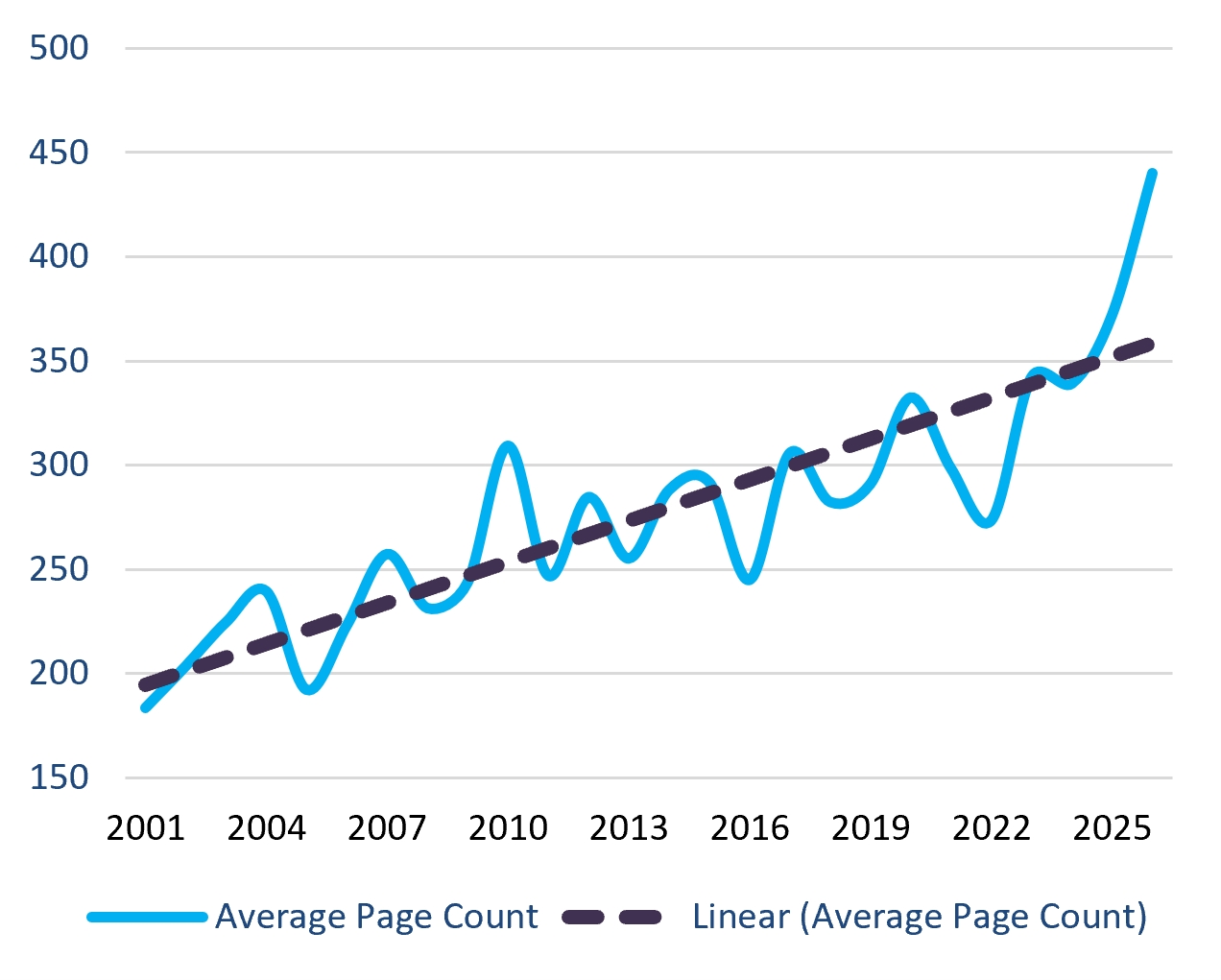
While page count is not itself a measure of disclosure quality, and ASIC recognises that schemes with novel structures, scrip or stub equity consideration or complex funding arrangements may properly require longer disclosure, the upward trend is clear and is not completely answered by transactions having become more complex.
In our experience, the materiality test is often applied by scheme proponents to determine what information must be included in a scheme booklet, but is applied less well in some instances to determine what may be left out. The cost of including superfluous information falls on members, who must work through a longer scheme booklet to find information relevant to their decision.
For example, ASIC recently intervened where most of the disclosure in a draft scheme booklet of approximately 1,500 pages was not, in our view, material to the decision facing members of that scheme. The statement ultimately registered with ASIC was reduced to approximately 500 pages.
We urge scheme proponents to consider:
- whether information has already been provided to members
- whether content has been carried across from earlier transactions without being tested against the circumstances of the particular scheme, and
- whether the same information already appears elsewhere in the statement.
ASIC will continue to pay close attention to these matters when reviewing draft scheme booklets to support members in making confident and informed decisions.
ASIC calls on industry to strengthen preparedness for geopolitically motivated disruption
ASIC urges licensees and market participants to strengthen their operational resilience and ensure they are prepared for disruption following recent advisories from the Australian Signals Directorate (ASD) warning of cyber activity linked to Russian state-sponsored actors.
The advisories are a timely reminder that geopolitical tensions, coupled with advancements in artificial intelligence (AI) and cyber exploitation capabilities, can quickly become operational resilience risks for financial markets, critical infrastructure, technology services and supply chains.
Licensees and market participants should expect, and prepare for, a more complex, less predictable operating environment.
ASIC calls on these entities to strengthen their risk management frameworks, governance and accountability, and prepare for potential geopolitical shocks and malicious activities. This includes following the advice of intelligence agencies such as ASD. Global events can have practical consequences for market resilience, affecting critical systems, services and third-party dependencies.
Earlier this year, ASIC issued an open letter, calling on industry to urgently strengthen their cyber resilience measures (26-092MR).
ASIC is closely monitoring market conditions and events offshore and is working with our Council of Financial Regulators counterparts and intelligence agencies to share information and assess risks as conditions evolve. Entities should act now by testing critical systems, protecting key dependencies and engaging on shared threats where they are identified.
ASIC’s regulatory resources include information about cyber security and good practices for cyber resilience.
Get ready for new director ID requirements from 1 July 2027
Companies and directors can take simple steps now to prepare for the new requirements, including checking that company and director information is current and accurate.
From 1 July 2027, new laws passed under the Treasury Laws Amendment (Business Registries Stabilisation and Uplift) Act 2026 will require companies to provide director identification numbers (director IDs) to ASIC.
Companies will need to provide director IDs to ASIC through company reporting processes, including annual reviews and when notifying changes to director details. Further information and guidance will be provided before 1 July 2027.
These changes form part of broader improvements to Australia's business registers, including stronger authentication arrangements for users who create and update registry records.
Together, they will help reduce the risk of fraud and identity misuse, improve the accuracy of company information, and make it easier to identify company directors.
Getting ready
Companies and directors are encouraged to check that company and director information is current and accurate, including:
- checking company details are up to date
- confirming all current directors are correctly recorded
- updating any incorrect names, addresses or contact details.
Keeping information up to date now may help avoid delays or issues when the new requirements commence.
We also encourage checking director details recorded on the ASIC companies register against those held by the Australian Business Registry Services (ABRS) and updating records where necessary.
Directors can review their director ID details by visiting the ABRS' Manage your director ID, where they can:
- download a PDF copy of their director ID details
- update their details if they have changed.
Next steps
ASIC is engaging with stakeholders and will provide further guidance ahead of the 1 July 2027 commencement date. ASIC may also communicate directly with affected stakeholders to support awareness and readiness.
Find out more
- Visit ASIC's Director identification numbers (director IDs) and FAQs
- Information flyer: Important changes to director ID obligations
- New laws to help Australians know who stands behind a company
ASIC moves to simplify sell-side research guidance to support capital raising activity
Regulatory guidance for Australia’s sell-side research will be reduced from 42 pages to just eight, under a new principles-based proposal by ASIC to facilitate greater investment in the local market.
The proposed revamp of Regulatory Guide 264 Sell-Side Research (RG 264) responds to industry feedback received through ASIC’s discussion paper on public and private markets, Australia’s evolving capital markets: A discussion paper on the dynamics between public and private markets, seeking clearer and less prescriptive guidance to encourage more research to support capital raising activity.
Sell-side research is prepared by AFS licensees such as investment banks and stockbrokers to help clients make investment decisions including about upcoming initial public offerings (IPOs).
ASIC has sought feedback on the changes that are designed to simplify the existing guidance by removing prescription and replacing RG 264 with a shorter, principles-based guide.
The updates will enable greater research analyst input into the IPO process - to facilitate capital raising activity - whilst requiring licensees to have effective arrangements to manage conflicts of interest, inside information and to preserve the independence of research.
The work forms part of ASIC’s response to feedback on the discussion paper, and also reinforces ASIC’s ongoing focus on regulatory simplification.
Submissions closed on 21 August 2026. A copy of the draft updated regulatory guide and a summary of the proposed changes are available on the consultation webpage at Simple Consultation 59 Proposed updates to RG 264 (CS 59).
Key themes and areas of focus from ASIC’s Financial Markets and Innovation roundtable
On 30 June 2026, ASIC convened a Financial Markets and Innovation Roundtable with 32 industry, academic and public sector participants coming together to discuss how to keep Australia’s capital markets resilient, efficient and globally competitive while supporting innovation with appropriate investor protections.
The Roundtable formed part of ASIC’s broader work to advance Australia’s evolving capital markets and coincided with the publication of Report 835 Innovation in Financial Markets and Financial Market Infrastructure – A Landscape Review (REP 835).
Some participants highlighted Australia's strengths, including trusted institutions, sophisticated investors and deep pools of capital, but warned that Australia risks global marginalisation unless it keeps pace with market developments.
Many urged prioritising innovation that solves practical problems, boosts productivity and strengthens foundations for capital formation, liquidity, collateral mobility and global connectivity in an era of major global capital raising and AI-enablement.
Roundtable participants brought diverse perspectives, but four interconnected themes emerged:
- preparing Australia for a more global market
- getting the foundations right for growth
- prioritising innovation to fix problems and boost productivity, and
- maintaining trust and investor protection.
The Roundtable was part of a continuing conversation. Australia's global competitiveness depends on strong and reliable infrastructure, effective coordination across public and private sectors, and a market ecosystem that supports innovation and growth, with appropriate guardrails in place.
For more information on the themes discussed and next steps, read the supporting news item, ASIC releases key themes and areas of focus from its Financial Markets and Innovation roundtable.