
Reportable situations data dashboard
Welcome to the reportable situations dashboard
How to use the dashboard
Page filters
You can apply filters using the drop-down options at the top of each page. Only one value from each filter can be selected at a time.
The filters selected on one page are applied to the other dashboard pages. Click ‘Clear filters’ to reset all filters on the dashboard.

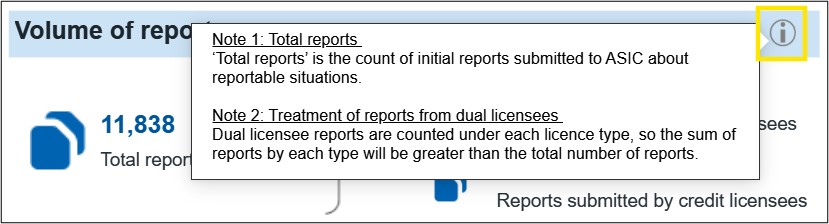
Information icons
Hover over information icons to view details about how to interpret the data or use the charts.
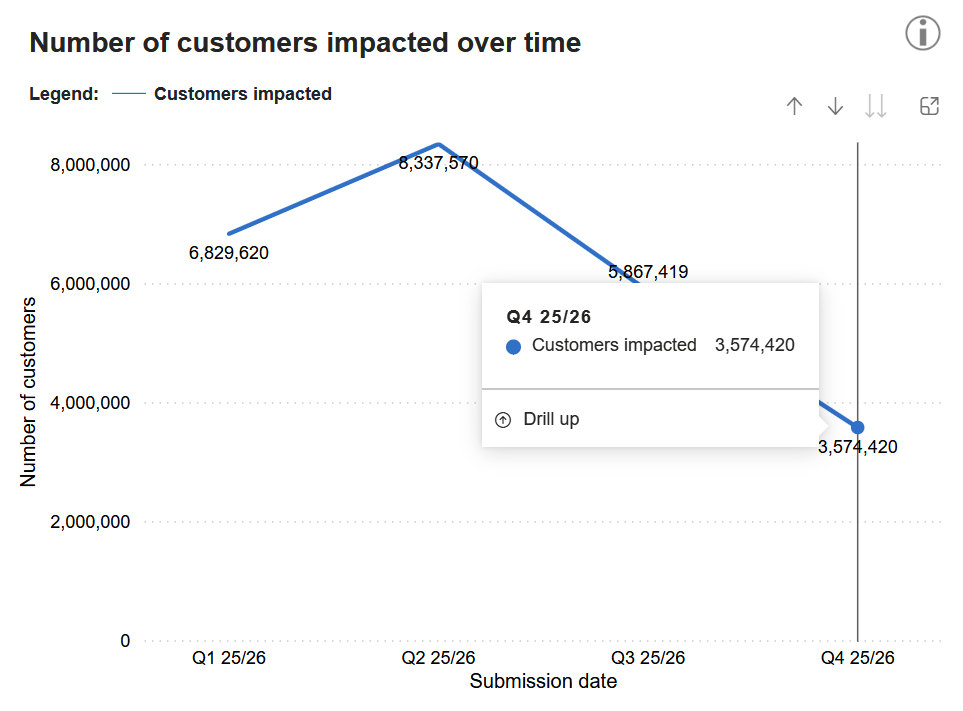
Tooltips
Hover over the data points in a chart to view information about them.
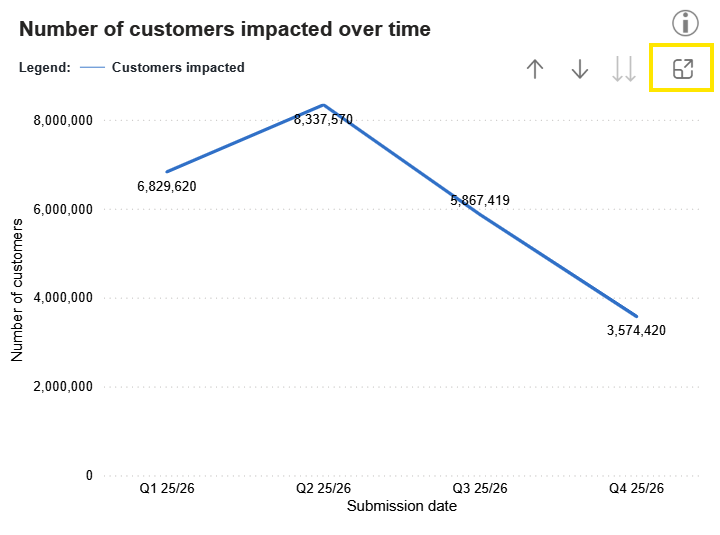
Focus mode
Hover over a chart and click on the focus mode icon in the top right to enlarge it.
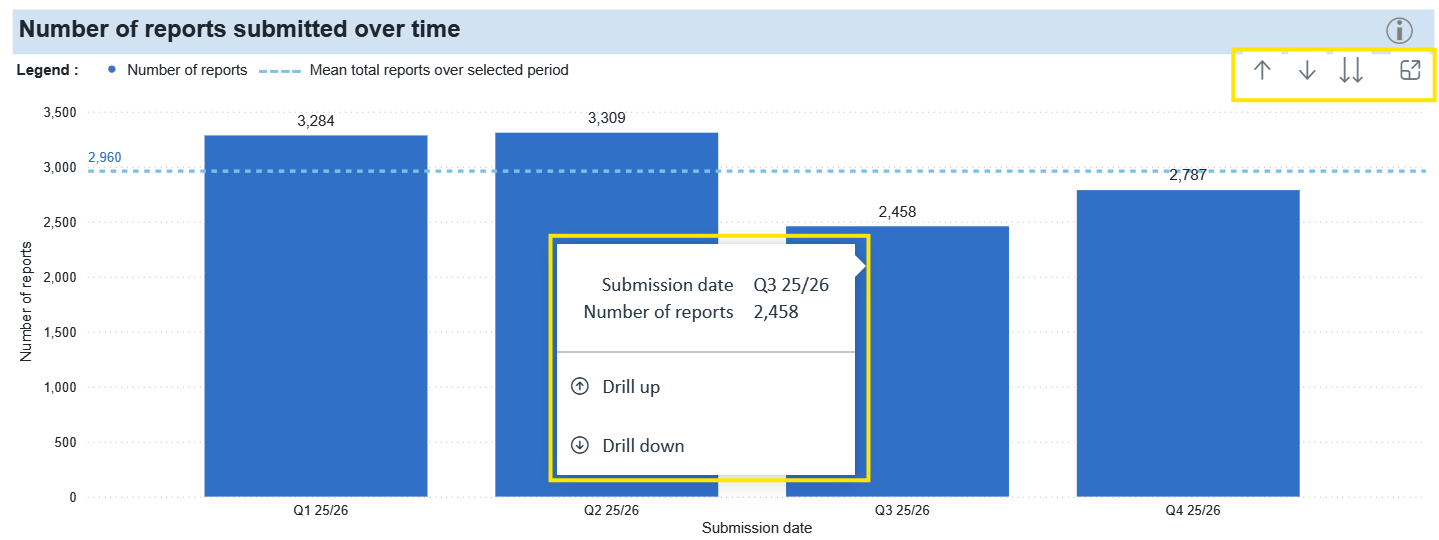
Drill mode for over time charts
Change between monthly, quarterly and yearly data in charts which show trends over time by hovering over the chart and using the arrows at the top right or the drill up/down buttons in the tool tips.
Sort function
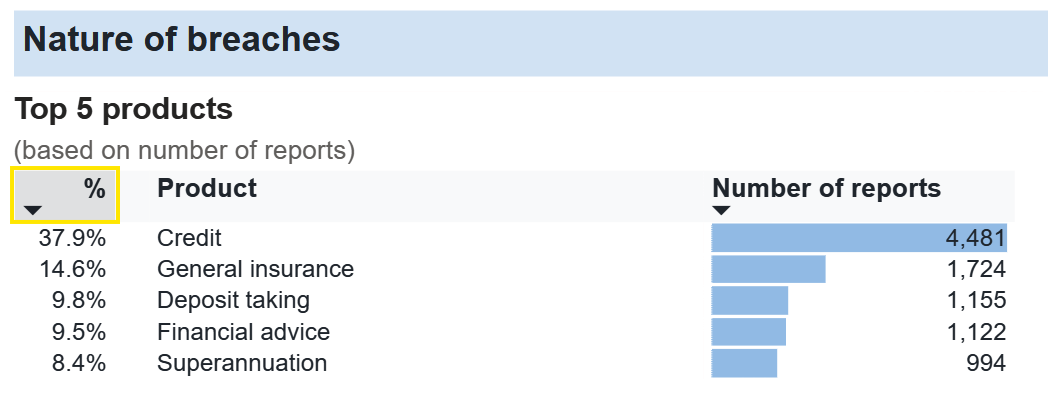
Reorder tables using the sort button available on each column header.
Show as table
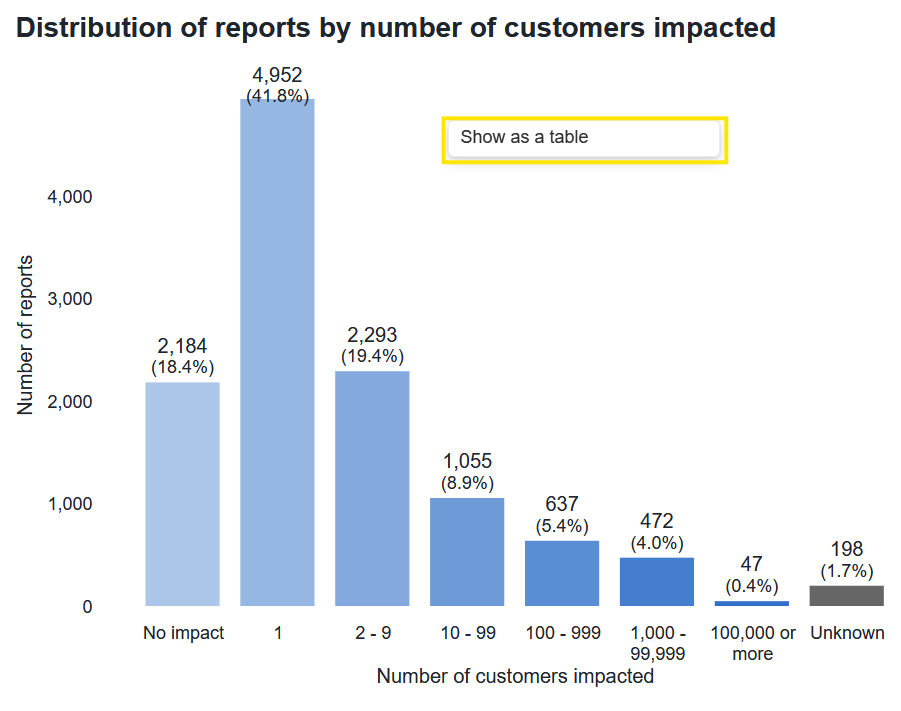
Right click on a chart and select ‘Show as table’ to display the selected data as a table. Click ‘Back to report’ from the ‘Show as table’ page to go back to the dashboard.
About the dashboard
Dashboard scope and methodology
Understanding the reportable situations regime
Enquiries
What do I do if I encounter issues with the dashboard?
To contact ASIC regarding any issues or concerns with the dashboard please use ASIC's online enquiry form. To ensure your enquiry is directed to the appropriate team, please select that your question is about a ‘Credit licensee’ or ‘Australian Financial Services licensee’ then select ‘RS dashboard’ from the list of options for “What you would like to know how to do”.
How to interpret the data
Interpreting volume and impact metrics
Report counts in the dashboard may not reflect the magnitude and impact of the reported breaches. As discussed in About the dashboard, licensees may choose to submit one report about an individual reportable situation if only one customer was impacted, or if there were multiple related situations in which thousands of customers were impacted.
Further, a large number of RS reports associated with a particular product or issue does not necessarily suggest a higher incidence of non-compliance, but may in fact reflect stronger compliance systems that can effectively identify and record non-compliance. Reporting volumes as well as measures of customer impact and loss can also be driven by licensee size, business models and reporting practices.
Interpreting timeframe metrics
A reasonable timeframe for each of the measures listed below can depend on a number of factors, including:
- the time taken to start and complete an investigation – can depend on the nature and complexity of a breach, the availability of data and/or contact information for customers, the size of the licensee, its approach to investigations, and reporting practices
- the time taken to complete rectification – can depend on the nature, complexity, and root cause of the matter, the size and processes of the licensee, along with reporting practices, and
- the time taken to finalise compensation of customers – can depend on the nature and complexity of the matter, the size of the licensee, the availability of data, the number of affected consumers, the quality of contact and payment information, and reporting practices.
Interpreting compensation metrics
For reports where compensation has been finalised, the total amount of customer financial loss may not equate to the amount of compensation paid to date due to various factors, including that:
- compensation amounts could include goodwill payments
- the breach may have involved a third-party error for which responsibility to compensate did not fall on the licensee, or
- compensation may be paid to charities where financial impact was very low (e.g. under certain thresholds set out in RG 277), and/or when money could not be returned to customers despite reasonable endeavours to do so.
The treatment of the above factors in reporting compensation and financial loss amounts may differ across licensees.
The use of estimates
The following metrics may include estimates where a licensee has not yet completed their investigation of a reported breach:
- number of customers impacted
- customer financial loss amount
- time taken to discover reported breach
- time taken to complete investigation
- time taken to complete rectification, and
- time taken to finalise compensation.
For details on how specific measures in the dashboard were calculated see the Data dictionary.
Additional data
Number of reports and updates
ASIC received 11,838 reports in FY25/26, along with 7,368 updates to reports. Of these updates, 3,838 related to reports submitted in previous financial years, while 3,530 related to reports submitted in FY25/26.
The dashboard continues to exclude 136 reportable situations reports submitted by 76 licensees in FY24/25, as well as 36 subsequent updates to those reports. ASIC will not publish further information about these reports.
Overview of changes to product and issue codes
On 15 June 2026, ASIC updated several product and issue codes to reflect regulatory updates and legislative reforms. Tables 1 and 2 outline the changes reflected in the FY25/26 dashboard data.
These changes affect how product and issue data appears across different dashboard pages and how results compare over time.
Table 1: New products for reportable situations from 15 June 2026
| Product level 1 | Product level 2 | Product level 3 | Changes for FY25/26 |
|---|---|---|---|
| Credit | Consumer credit | New - Buy now, pay later (Low cost credit contract)
Previously - Buy now, pay later |
Active from 15 June 2026 |
| Credit | Consumer credit | New - Buy now, pay later (Low cost credit contract)
Previously - Buy now, pay later |
Active from 15 June 2026 |
| Credit | Consumer credit | New - Buy now, pay later (not Low cost credit contract)
Previously - Buy now, pay later |
Active from 15 June 2026 |
| Investments | Derivatives/hedging | New - Digital assets
Previously - Cryptocurrency |
Active from 15 June 2026 |
| Investments | Managed investments | New - Digital assets
Previously - Crypto assets |
Active from 15 June 2026 |
| Investments | Securities that are interests in a CCIV | New - Digital assets
Previously - Crypto assets |
Active from 15 June 2026 |
| New - Mutual risk products | n/a | n/a | Active from 15 June 2026 |
| Payment systems | Non-cash | New - Digital asset payment | Active from 15 June 2026 |
Table 2: New issues for reportable situations from 15 June 2026
| Issue level 1 | Issue level 2 | Changes for FY25/26 |
|---|---|---|
| Financial firm decision - Specific to credit and lending | New - Responsible lending (excluding modified obligations for Low cost credit contracts)
Previously - Responsible lending |
Active from 15 June 2026 |
| Financial firm decision - Specific to credit and lending | New - Responsible lending (modified obligations for Low cost credit contracts)
Previously - Responsible lending |
Active from 15 June 2026 |
Size and type of licensees reporting to ASIC
Tables 3 and 4 show insights into the number, size and type of AFS licensees and credit licensees that submitted reports to ASIC during FY25/26.
Table 3: Breakdown of AFS licensee reporting by size, based on Form FS70 lodgements
| Total revenue | Number of licensees that submitted an RS report | Percentage of licensees that submitted an RS report | Number of RS reports | Percentage of RS reports | Percentage of total AFS licensee population | Percentage of revenue reported by AFS licensee population |
|---|---|---|---|---|---|---|
| Less than $50m | 935 | 78.2% | 2,417 | 31.5% | 17.8% | 25.6% |
| $50m–$249m | 139 | 11.6% | 824 | 10.7% | 48.1% | 50.6% |
| $250m–$999m | 50 | 4.2% | 772 | 10.1% | 56.2% | 53.2% |
| $1,000m or more | 41 | 3.4% | 3,592 | 46.8% | 75.9% | 88.7% |
| No revenue figure available | 30 | 2.5% | 68 | 0.9% | 3.7% | - |
| Total | 1,195 | 100% | 7,673 | 100% | 18.4% | 79.8% |
Table 4: Breakdown of credit licensee reporting by size, based on Form CL50 lodgements
| Total credit | Number of licensees that submitted an RS report | Percentage of licensees that submitted an RS report | Number of RS reports | Percentage of RS reports | Percentage of total credit licensee population |
|---|---|---|---|---|---|
| Less than $200m | 60 | 34.5% | 145 | 3.2% | 1.6% |
| $200m–$1,799m | 57 | 32.8% | 215 | 4.8% | 25.2% |
| $1,800m or more | 54 | 31.0% | 4,138 | 91.5% | 65.9% |
| No credit value available | 3 | 1.7% | 22 | 0.5% | 0.9% |
| Total | 174 | 100% | 4,520 | 100% | 4.0% |
Note 1: The licensee size information is based on the revenue, including tax benefit, specified in the latest Form FS70 lodgement by the relevant AFS licensees, and the credit value specified in the latest Form CL50 lodgement by the relevant credit licensees as at 30 June 2026. Where data was not available for the most recent financial year, we used data about financial years from 1 July 2023 onwards.
Note 2: A licensee may be classified as ‘No revenue figure available’ or ‘No credit value available’ for a number of reasons, including that as at 30 June 2026, ASIC had not received any Form FS70 lodgements or Form CL50 lodgements about the financial years from 1 July 2023 onwards, or the licensee is exempt from lodging.
Note 3: The ‘Percentage of total licensee population’ figures are calculated as the number of licensees who submitted an RS report as a percentage of the total number of licensees within each size bucket that had a status of ‘Current’ as at 30 June 2026 in ASIC’s AFS licensees register or credit licensees register.
Note 4: The ‘Percentage of revenue reported by licensee population’ for each size bucket is calculated by dividing the total revenue of AFS licensees in that bucket that submitted an RS report by the total revenue of all AFS licensees in the same bucket with a status of ‘Current’ in ASIC’s AFS licensee register as at 30 June 2026.
Note 5: The total ‘percentage of revenue reported by licensee population’ in Table 3 is calculated by dividing the total revenue of AFS licensees that submitted an RS report by the total revenue of all AFS licensees with a status of ‘Current’ in ASIC’s AFS licensee register as at 30 June 2026. Licensees for which no revenue figure was available are excluded.
Reports submitted to APRA
A small number of reports about reportable situations involving entities regulated by both APRA and ASIC were submitted directly to APRA under the APRA dual reporting framework. These reports are excluded from the dashboard.
During FY25/26, 11 licensees submitted 38 reports to APRA about matters that fell within ASIC’s reportable situations regime. This included 10 RSE licensees, which are trustees of superannuation funds, and one other licensee. To date, these licensees reported that the breaches impacted approximately 1.27 million customers and resulted in total financial losses of $2,710,409.
Previous years
Disclaimers
Data accuracy
The data in this dashboard is self-reported by licensees and not assured by ASIC and is subject to the constraints of the various recording and reporting practices of licensees which are not controlled by ASIC.
To aid in transparency, the reportable situations data has been published as it was reported to ASIC. ASIC does not verify that the data reported (or not reported) by licensees accurately reflects their progress in identifying, rectifying and remediating breaches.
Licensees can update and correct data in the dashboard by submitting an update report to ASIC through our Regulatory Portal. The dashboard will be refreshed annually, and as outlined on About the dashboard, any updates will be reflected in the refreshed data.
Not advice
Dashboard users should not use the data presented in this dashboard as the sole basis for making financial decisions. Consumers should seek advice before making any financial decisions. To the extent permitted by law, ASIC does not warrant the accuracy of the data presented in this dashboard and accepts no liability for any losses arising out of improper use, or release of information in the dashboard.
Nature of reports
Licensees are required to report to ASIC when they have reasonable grounds to believe that a reportable situation has occurred. However, a report submitted to ASIC does not amount to a determination of liability made by ASIC or other authority such as a court.
Privacy
ASIC has taken steps to protect personal and sensitive information reported through reportable situations reports, including by removing any free text fields from the publication. If you have any concerns about the handling of personal information in the publication, please use ASIC's online enquiry form to contact us. Visit https://www.asic.gov.au/privacy for further information on how ASIC handles personal information.
Data Dictionary
| Key term | Definition |
|---|---|
| AFS licence | An Australian financial services licence under s913B of the Corporations Act 2001 that authorises a person who carries on a financial services business to provide financial services.
Note: This is a definition contained in s9 of the Corporations Act 2001. |
| AFS licensee | A person who holds an AFS licence under s913B of the Corporations Act 2001. |
| APRA | Australian Prudential Regulation Authority. |
| ASIC | Australian Securities and Investments Commission. |
| ASIC Regulatory Portal | The internet channel that allows authenticated regulated entities to interact securely with ASIC, accessible on the ASIC Regulatory Portal landing page. |
| Breach | In this dashboard, an incident or event within a licensee’s organisation that has amounted to one of the following types of reportable situations:
|
| Compensation | In this dashboard, a type of remediation which involves returning customers who have suffered financial loss as a result of a breach to the position they would have otherwise been in through the use of monetary payments. |
| Core obligation | The general obligations of AFS licensees and credit licensees. For a summary of the core obligations for AFS licensees and credit licensees, see Appendix 1 of RG 78. |
| Corporations Act | Corporations Act 2001 (Cth), including regulations made for the purposes of that Act. |
| Credit licence | An Australian credit licence under s35 of the National Consumer Credit Protection Act 2009 that authorises a licensee to engage in particular credit activities. |
| Credit licensee | A person who holds an Australian credit licence under s35 of the National Consumer Credit Protection Act 2009. |
| Financial year (FY) | The period from 1 July to 30 June. |
| Initial submission date | The date a report was initially submitted to ASIC. |
| Investigation | In this dashboard, the process that a licensee conducts to determine the root cause of that breach and identify all customers affected and the extent of customer impact. |
| Licensee | An AFS licensee and/or credit licensee. |
| Likely breach | Also referred to as a likely significant breach, is a situation where a licensee or a representative of the licensee is no longer able to comply with a core obligation and the breach, if it occurs, will be significant. Note: See s912D(1)(b) of the Corporations Act or s50A(1)(b) of the National Consumer Credit Protection Act. |
| National Credit Act | National Consumer Credit Protection Act 2009 (Cth). |
| Prevention | A process undertaken by a licensee to prevent re-occurrence of the breach. |
| Preventative measures | The measures a licensee undertakes to reduce the likelihood of a breach re-occurring. |
| Rectification | A process undertaken by a licensee to fix the root cause of a breach. |
| Remediation | A process, large or small, to investigate the scope of the misconduct or other failure and, if appropriate, return consumers who have suffered loss as a result of the misconduct or other failure to the position they would have otherwise been in, as closely as possible. This could be by way of monetary and/or non-monetary remedies (for further guidance please see RG 277: Consumer Remediation). |
| Report(s) | A report about a reportable situation/s. Does not include updates to reports. |
| Reports with previous similar reportable situations | Reports determined by the licensee as similar to a previously reported reportable situations based on factors such as the nature of the issue and breach, the legislative provision contravened, root cause, type of controls in place, and customer impact. |
| Reportable situation | Has the meaning given by s912D of the Corporations Act 2001 or s50A of the National Consumer Credit Protection Act 2009. |
| RG 78 (for example) | An ASIC regulatory guide (in this example numbered 78). |
| s912D (for example) | A section of the Corporations Act (in this example numbered 912D). |
Dashboard measures
Below are the definitions and calculations of the key measures used throughout the dashboard. The calculations are derived from the questions that licensees are required to answer when submitting a reportable situations report through the ASIC Regulatory Portal. For more information on the questions in the report, see How to submit a reportable situation.
| Term | Definition |
|---|---|
|
Amount of compensation paid to date |
Where compensation is undertaken, the total dollar amount paid in compensation to customers to date. |
|
Compensation status |
The status of a licensees’ compensation activities. |
|
Customers compensated to date |
Where monetary compensation is undertaken, the total number of customers compensated to date. |
|
Customer financial loss amount |
Total or estimated financial loss experienced by customers that have been affected by a breach. |
|
Customers impacted |
Total or estimated number of customers that have been affected by a breach. |
|
Distribution of reports by customer financial loss |
Groups total reports by the customer financial loss amount associated with the report. Refer to the above related dashboard measure “Customer financial loss amount” for further information. |
|
Distribution of reports by number of customers impacted |
Groups total reports by the number of customers impacted. Refer to the above related dashboard measure “Customers impacted” for further information. |
|
Investigation status |
Where an investigation into the breach has commenced, licensees report the status of their investigation as either complete or incomplete. |
|
Investigation trigger |
The action that triggered the investigation or made the licensee aware of the breach. Triggers can be grouped into internal, external, regulator and other. For further guidance refer to RG 78 Table 12: Investigation trigger definitions. |
|
Issue |
The type of general issue to which the report relates. It could be an activity, action or circumstance that led to the reportable situation described in the report There are two tiers of issue types shown on the “Nature of breaches” pages of the dashboard. |
|
Licence type |
This measure breaks down the licence/s type a breach is related to. A dual licence holder can select whether the report relates to their AFS licence, their credit licence, or both. Reports relating to both licences have been counted under each licence type. |
|
Prevention status |
Where an investigation into the breach has sufficiently progressed, licensees report the status of activities undertaken to prevent re-occurrence of the breach. |
|
Product |
The financial service, credit activity, or product line (product line or service) to which a report relates to. There are three tiers of product types shown on the “Nature of breaches” pages of the dashboard. |
|
Rectification method |
The method by which a licensee achieves rectification of the breach. |
|
Rectification status |
Where a breach requires rectification to fix its underlying cause, licensees report the status of their rectification activities. |
|
Remediation method |
The type of remediation method utilised by the licensee to return the customer to the position they would have otherwise been in had the breach not occurred. A report can be associated with more than one remediation method. |
|
Reports that have at least one previous similar reportable situation |
Licensees are required to identify whether a breach is similar to a previously reported reportable situation based on factors such as the nature of the issue and breach, the legislative provision contravened, root cause, type of controls in place, and customer impact. |
|
Root cause |
The type of underlying cause of a breach (e.g. staff negligence or system deficiency). A report can be associated with more than one root cause. For further guidance please see RG 78 Table 11: Guidance on root cause category options. |
|
Significance reason |
The reason a breach was deemed or determined to be significant under the meaning outlined in s912D (4) and (5) of the Corporations Act and s50A (4) and (5) of the National Credit Act. For further guidance refer to ASIC RG 78.31 – 78.47). A report can be associated with more than one significance reason. |
|
Time taken to complete investigation (from start of investigation) |
The actual or estimated time taken to complete an investigation into a breach from when the investigation was started. |
|
Time taken to complete rectification (from first discovered) |
The actual or estimated time taken from when the breach was first discovered to the date rectification was completed. |
|
Time taken to discover reported breach (from first instance) |
The time taken from when the breach first occurred to when the licensee first discovered the breach. |
|
Time taken to finalise compensation (from first discovered) |
The actual or estimated time taken from when the breach was first discovered to the date compensation was completed. |
|
Time taken to start investigation (from first discovered) |
The time taken from when the licensee first discovered the breach to when they started their investigation. |
|
Total reports |
The number of reports where the report’s initial submission date falls within the selected reporting period. The number of reports does not include updates to a report after it has been initially submitted. The measure is calculated as the count of initial reports. |
Key insights and trends
This page provides high-level insights into breaches reported by licensees including the volume and nature of breaches, the extent of their impact on customers, and the progress licensees have made investigating, remediating and rectifying those impacts.
Volumes and significance reasons
This page allows users to explore trends over time in the number of reports about breaches submitted by licensees, as well as the reason/s those reports were considered significant.
Customer impact and loss
This page allows users to explore the customer impact of breaches reported by licensees, including the number of customers affected and any financial loss, or non-financial losses (such as delays or poor customer experience) suffered.
Please note that these measures may include estimates provided by a licensee where an investigation is not yet complete.
Nature of breaches
This page allows users to explore the types of breaches reported by breaking down total reports by product, issue and root cause.
Nature of breaches over time
This page allows users to explore trends in the types of breaches reported over time by breaking down total reports by product, issue and root cause.
Warning: When viewing products at levels 2 and 3 and issues at level 2, we recommend filtering to a particular level 1 product and/or issue using the page filters. The large number of categories contained within each of these levels cannot all be shown in the charts at one time. The slider button on the y-axis of each chart can also be used to zoom in or out of the charts.
Identification of breaches
This page allows users to explore how quickly licensees are identifying breaches, and to understand the trigger that made licensees aware of the matter, or start their investigation.
Investigation of breaches
This page allows users to explore licensees’ progress and timeliness in commencing and finalising investigations into the cause and impact of breaches. Timely investigations reduce the risk of continuing or recurring breaches by identifying the root or systemic cause of the breach; they also enable quicker remediation.
Rectification of breaches
This page allows users to explore licensees’ progress in rectifying the underlying cause of a breach and implementing preventative measures to reduce the likelihood of the breach re-occurring. It also provides details on the types of rectification methods used by licensees.
Remediation of impacted customers
This page allows users to explore licensees’ progress in compensating customers, as well as the types of remediation provided to customers. Remediation may take the form of monetary payments (compensation), or other non-monetary remedies such as a change in contract terms or an apology.