

Equity market data for quarter ending March 2026
For an explanation of the measures used in this release, see Information Sheet 177 Quarterly cash equity market data: Methodology and definitions (INFO 177).
Summary for Quarter Ending March 2026
Market Share and Turnover
- In the March 2026 quarter, ASX accounted for 81.9% of the total dollar turnover in equity market products, up slightly from 81.5% in the December quarter. Cboe accounted for the remaining 18.1%.
- These figures include all trades executed on order book, as well as trades matched off order book and reported to either market operator.
- Average daily turnover in the Australian equity market was $11.2 billion for the March quarter, an increase of $1.3 billion from the December quarter.
Turnover Composition (as a proportion of total dollar turnover)
- On order book turnover (excluding ASX auctions) increased to 58.0% in the March quarter from 56.1% in the December quarter.
- Trade reporting turnover decreased to 17.3%, compared to 19.6% in the December quarter.
Market Concentration
ASX’s market share, measured by the Herfindahl‑Hirschman Index (HHI) remained at 0.65 in the March quarter (maximum 1.00).
Order‑to‑trade ratio
The overall ratio increased to 8.9:1 in the March quarter from 8.7:1 in the December quarter.
Liquidity
- Depth of the orderbook across the best bid and ask in the March 2026 quarter reached an average of $506,000 across the largest 200 securities and $490,000 across all securities, compared to $649,000 and $614,000 last quarter, respectively.
- Quoted spreads in the March quarter have decreased for the largest 200 securities, currently at an average of 9.45 bps from 9.74 bps last quarter. Across all securities, quoted spreads have decreased, at 17.57 bps from 18.21 bps last quarter.
- Effective spreads have decreased across the largest 200 securities, at 10.29 bps from 10.50 bps last quarter, and decreased across all equity products, at 19.22 bps in the March quarter from 19.76 bps previously.
Table 1: Market characteristics – average for March quarter 2026
| Statistics | ASX on book | ASX Auctions | ASX Centre Point | ASX trade reporting | Cboe on book | Cboe trade reporting | Total | Change |
|---|---|---|---|---|---|---|---|---|
| Number of trades per day | 2,145,685 | 83,615 | 438,863 | 130,810 | 840,251 | 139,243 | 3,778,466 | ▲ |
| (market share) | 56.8% | 2.2% | 11.6% | 3.5% | 22.2% | 3.7% | 100.0% | |
| Value traded ($ million/day) | 4,617.4 | 2,773.6 | 716.3 | 1,085.6 | 1,186.2 | 863.3 | 11,221.3 | ▲ |
| (market share) | 41.1% | 24.7% | 6.4% | 9.7% | 10.6% | 7.7% | 100.0% | |
| Order-to-trade ratio | 8.2 | na | 7.0 | na | 11.8 | na | 8.9 | ▲ |
| Average trade size ($/trade) | 2,150.1 | 32,922.8 | 1,635.1 | 8,229.7 | 1,410.5 | 6,171.9 | 2,964.7 | ▼ |
Table 2: Measures of market concentration
| Statistics | Q4 2025 average | Mar 2025 | Jan 2026 | Feb 2026 | Mar 2026 | Change from previous quarter |
|---|---|---|---|---|---|---|
| Total market | 0.43 | 0.45 | 0.46 | 0.44 | 0.46 | ▲ |
| Public venues | 0.65 | 0.67 | 0.65 | 0.65 | 0.67 | - |
Table 3: Measures of market efficiency
| Market Efficiency Statistics | Q4 2025 average | Mar 2025 | Jan 2026 | Feb 2026 | Mar 2026 | Change from previous quarter |
|---|---|---|---|---|---|---|
| Quoted bid-ask spread (bps) | ||||||
| Top 200 securities by turnover | 9.74 | 9.79 | 10.27 | 8.60 | 9.50 | ▼ |
| All Securities | 18.21 | 15.06 | 20.10 | 16.31 | 16.30 | ▼ |
| Effective bid-ask spread (bps) | ||||||
| Top 200 securities by turnover | 10.50 | 10.03 | 11.22 | 9.39 | 10.27 | ▼ |
| All Securities | 19.75 | 15.70 | 22.15 | 17.90 | 17.60 | ▼ |
| Best depth ($) | ||||||
| Top 200 securities by turnover | 649,443.32 | 533,481.76 | 505,765.95 | 485,047.19 | 527,597.13 | ▼ |
| All Securities | 614,467.29 | 511,010.63 | 487,940.86 | 478,213.90 | 503,447.40 | ▼ |
Note: BLD in July 2021, SYD in February 2022, CIM in Mar 2022 and MCR in Q2 2023 are excluded when computing depth metrics.
Figure 1: Market share – March quarter 2026
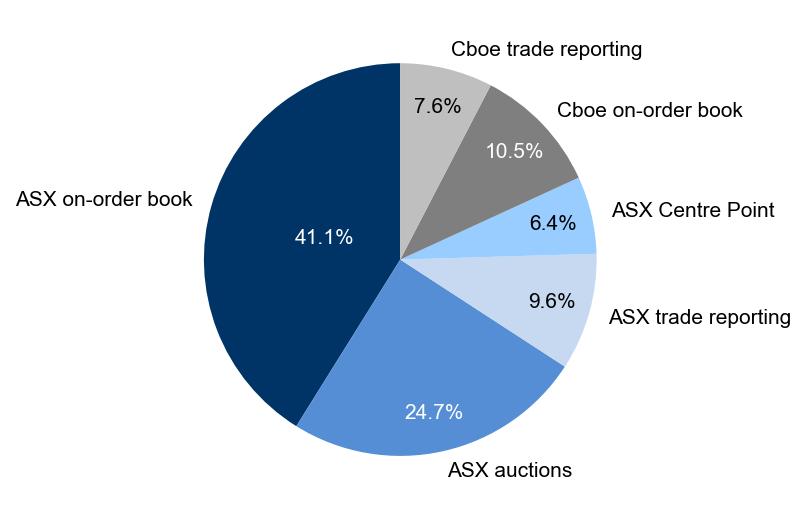
Figure 2: Average daily turnover
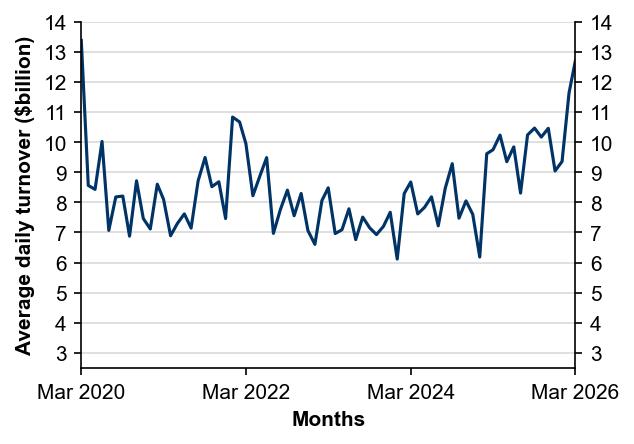
Figure 3: Average trade size by execution venue
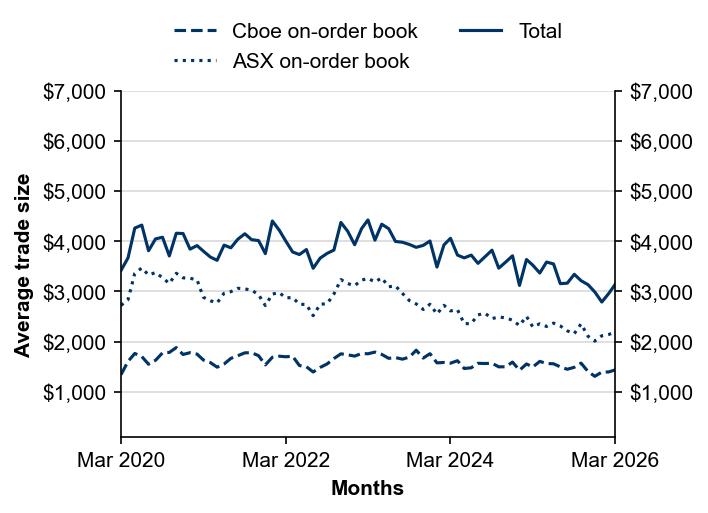
Figure 4: Dark liquidity proportion of total value traded
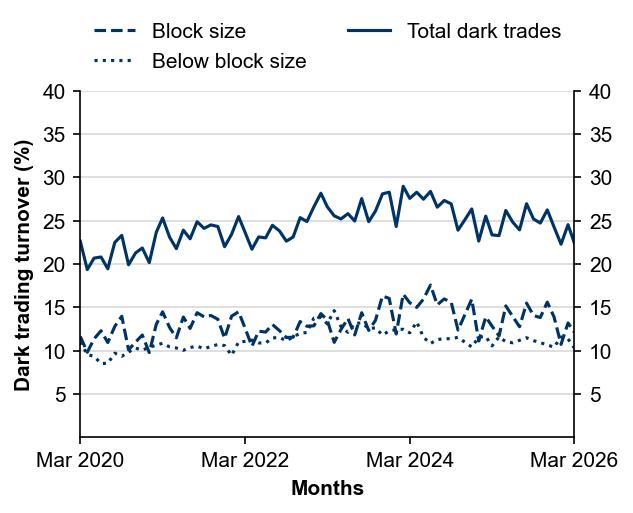
Figure 5: Order-to-trade ratio
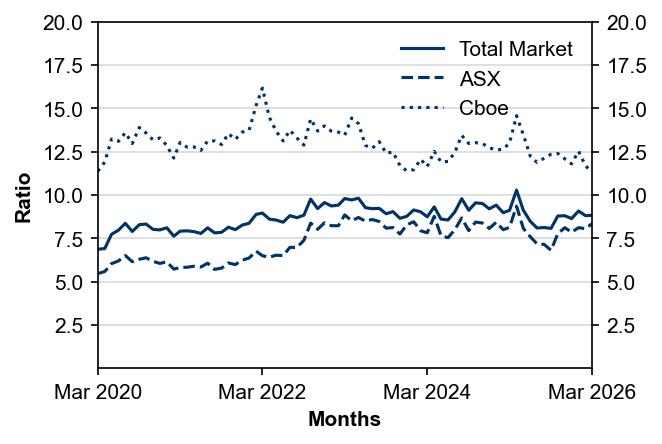
Figure 6: Intraday on-market trading profile – March quarter 2026
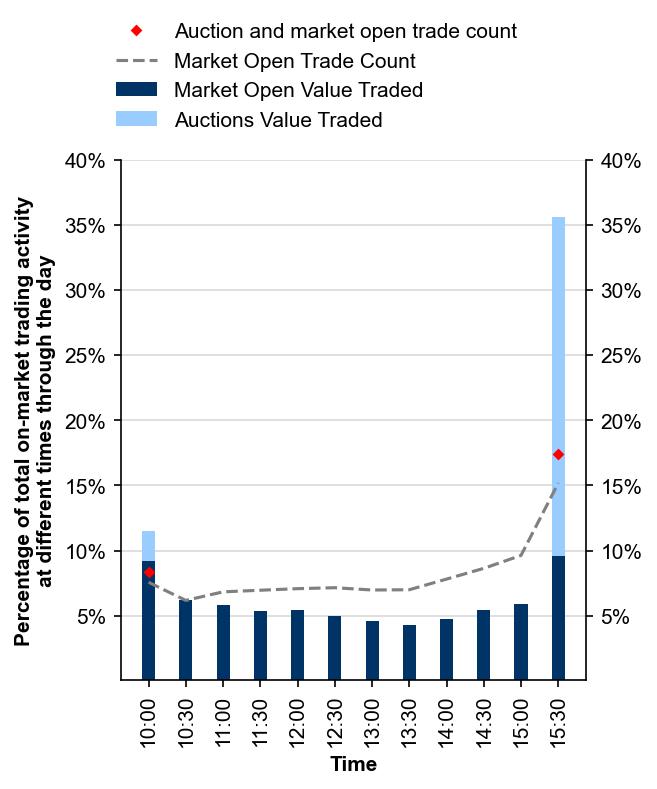
Figure 7: Intraday volatility
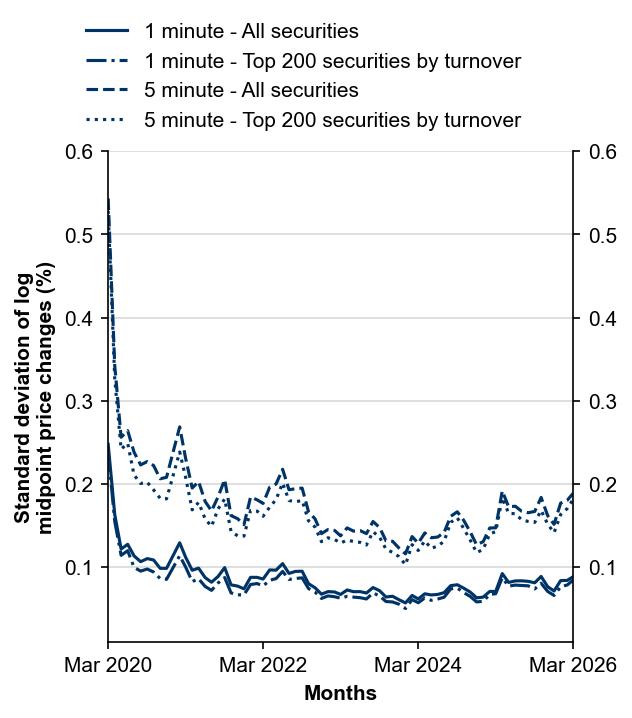
Figure 8: Interday Volatility
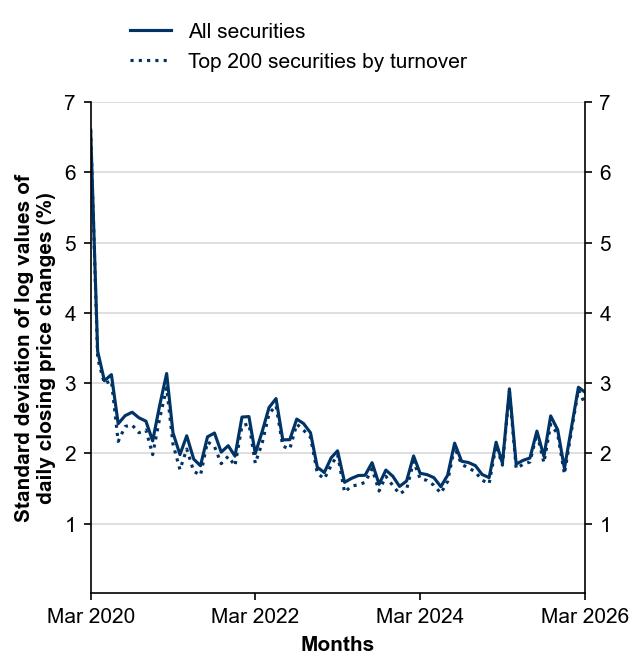
Figure 9: Herfindahl index
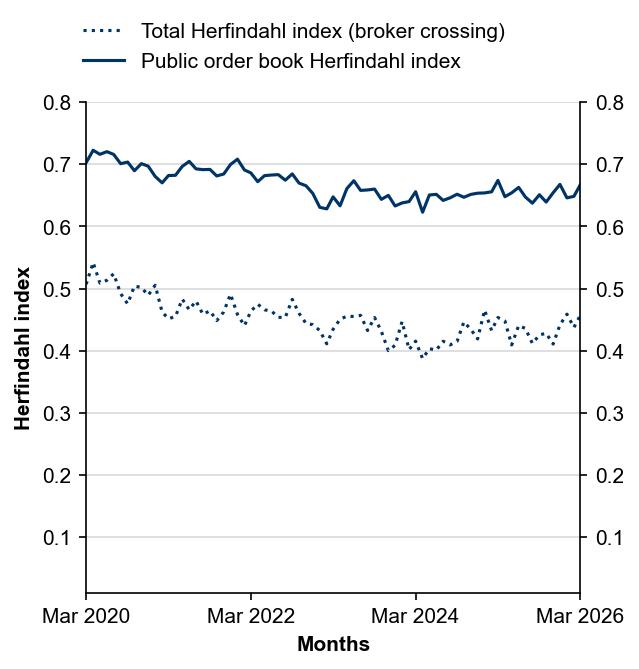
Figure 10: Effective bid-ask spreads
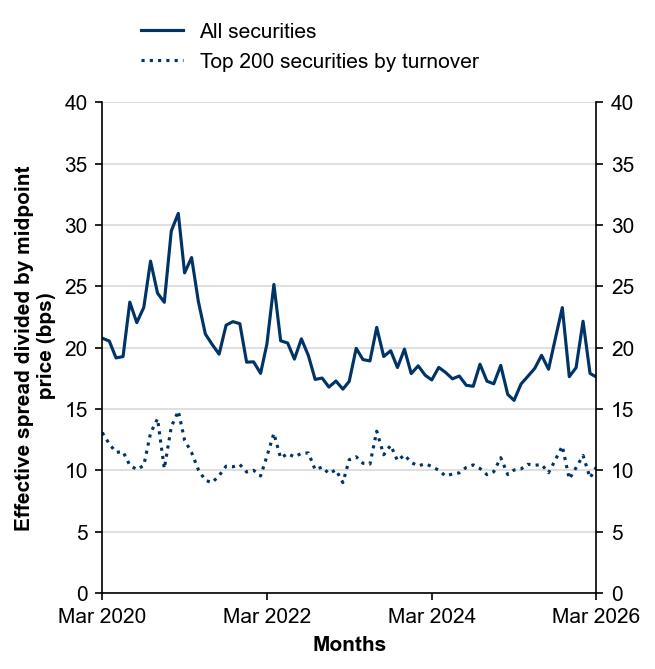
Figure 11: Quoted bid-ask spreads
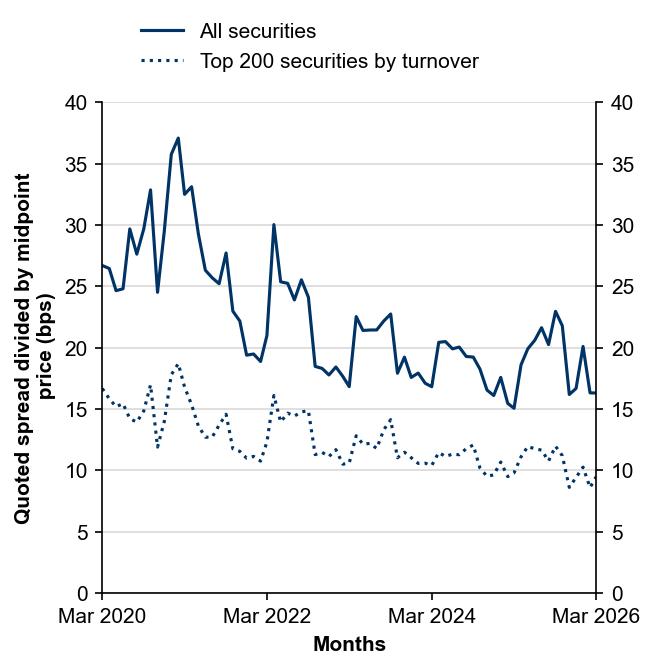
Figure 12: Depth at best bid and ask prices
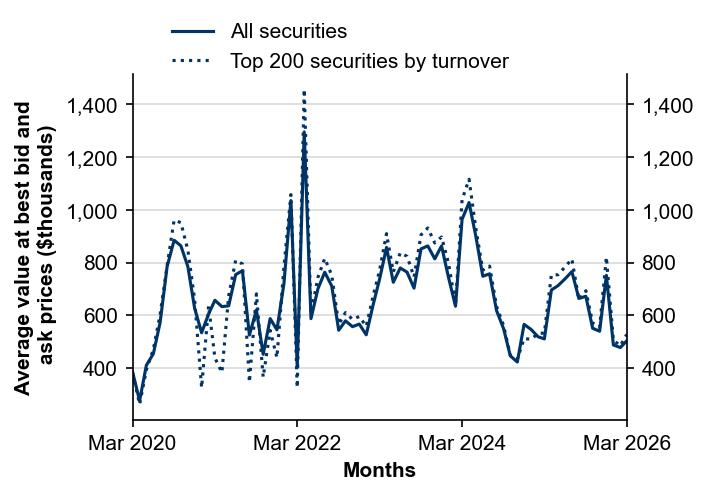
Note: BLD in July 2021, SYD in February 2022, CIM in Mar 2022 and MCR in Q2 2023 are excluded when computing depth metrics.