
ASIC's governance and accountability
ASIC’s governance and accountability structures are consistent with ASIC being an independent Commonwealth agency that is a statutory body corporate. They reflect the legislative framework within which ASIC operates.
ASIC’s governance and accountability framework
ASIC’s governance and accountability framework (the Framework) sets out a clear, transparent and common understanding of ASIC’s governance and accountability structures and processes. The objective of the Framework is to promote effective, efficient and impartial decision making at ASIC and articulate clear accountabilities. The Framework seeks to ensure ASIC acts strategically, with integrity and effectively delivers on its statutory objectives.
The Framework sets out how the Commission will collectively exercise its functions and powers, as well as delegate to others. It helps ASIC to achieve its strategic priorities, manage risks and use resources responsibly.
ASIC is a body corporate established under the Australian Securities and Investments Commission Act 2001 (Cth) (ASIC Act). ASIC is made up of Commissioners who are appointed by the Governor General on nomination of the Minister.
Under the ASIC Act, Parliament has conferred functions and powers on the Commission and Chair of ASIC. ASIC’s functions and powers are also drawn from the laws we administer.
ASIC’s governance and accountability structures are consistent with ASIC being an independent Commonwealth agency that is a statutory body corporate and reflects the legislative framework within which ASIC operates. The Framework separately identifies decision-making in relation to governance matters and regulatory functions. It supports the Commission to exercise its functions and powers and oversee delegated matters.
The current Framework was introduced in December 2019 as part of ASIC’s strategic change program and to reflect ASIC’s revised leadership structure. It is regularly reviewed and updated.
A key purpose of the Framework is to enable the Commission to spend more time focusing on and setting ASIC’s strategy.
Commission and Accountable Authority
The Commission is ASIC’s governing body and is responsible for achieving ASIC’s statutory objectives set out in the ASIC Act. It acts as a strategic non-executive body focusing on significant and strategic regulatory and statutory decision-making and stakeholder management. It provides support to the Chair on organisational oversight.
The Commission makes important regulatory decisions, sets ASIC’s strategy and oversees ASIC’s delivery and performance against the strategy. In addition, the Chair is ultimately responsible for the duties of the Accountable Authority contained in the Public Governance Performance and Accountability Act 2013 (PGPA Act) which forms part of the executive responsibilities of governing ASIC.
The following table outlines the dual regulatory and governance roles of the Commission:
| Regulatory role | Governance role (shared between the Accountable Authority and Commission) |
|---|---|
| Making strategic and/or significant regulatory decisions related to ASIC’s statutory powers and functions. | Providing strategic leadership by setting ASIC’s vision, risk appetite and corporate plan, determining budget and resourcing priorities, ASIC’s Values and Code of Conduct and overseeing management performance and accountability and audit processes |
ASIC’s governance structure
ASIC’s governance structure supports the Commission in exercising its functions and powers by providing oversight of delegated matters and a structure for executives to elevate matters to the appropriate forum.
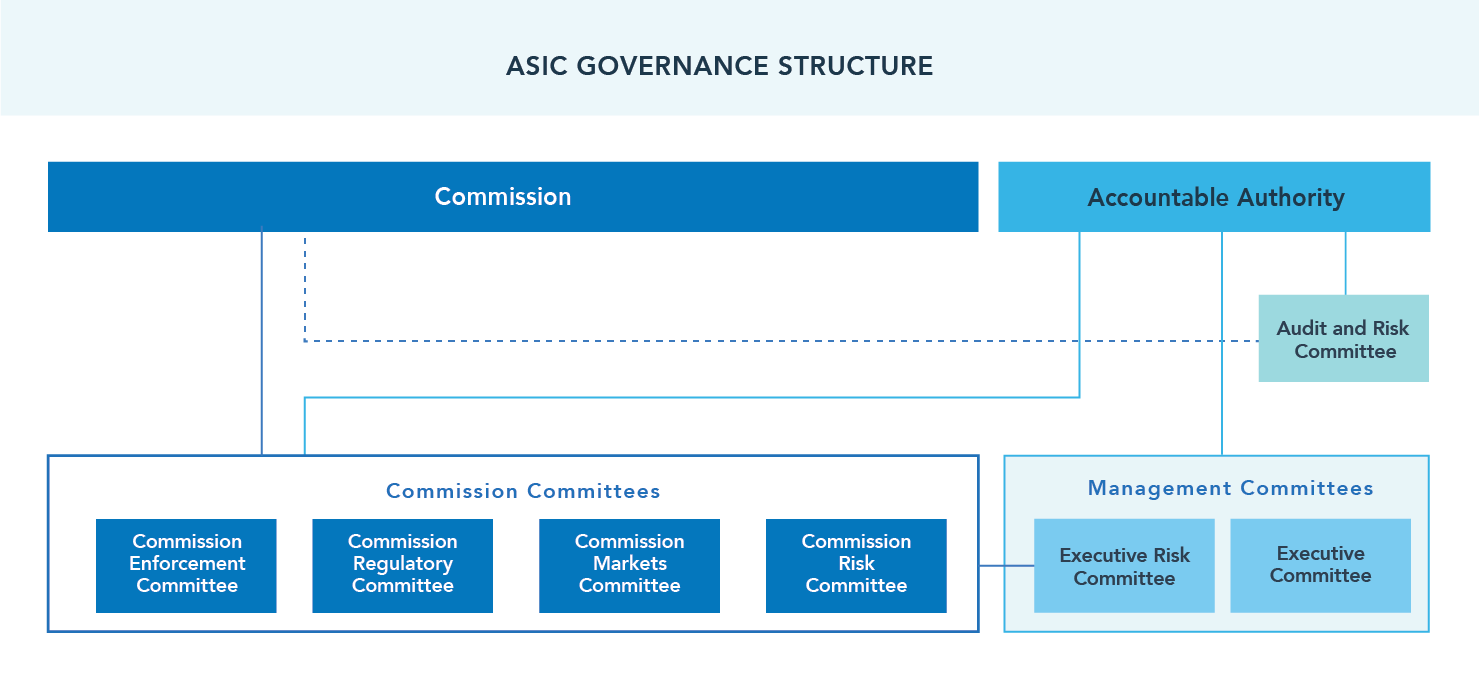
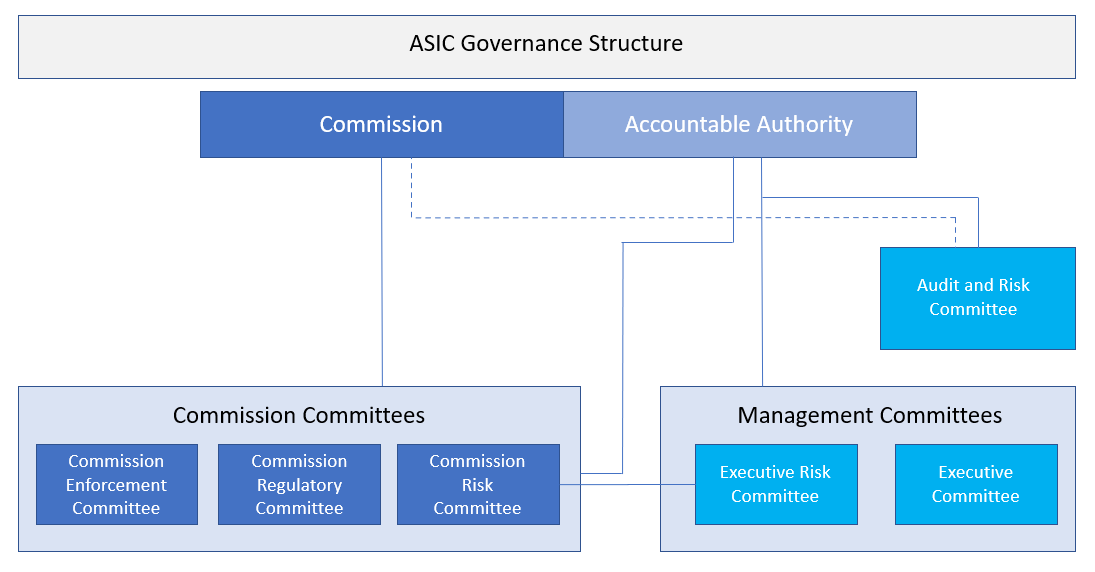
The Commission has established a number of committees to assist it with the effective and efficient performance of its dual regulatory and governance roles. The Commission undertakes these roles through Commission meetings, Commission Committees, Specialist Committees, Governance Committees and Management Committees.
ASIC may establish other sub-committees and boards from time to time.
More information
Commission meetings
Commission meetings are convened by ASIC’s Chair under Section 103 of the ASIC Act. They generally take place weekly or as required.
The Commission is responsible for the exercise of ASIC’s functions and powers, strategic direction and priorities. The Commission:
- oversees and ensures that ASIC’s objectives as set out in section 1(2) of the ASIC Act are met
- exercises and oversees the exercise of the functions and powers conferred by the Corporations Act 2001 and the ASIC Act
- sets ASIC’s strategy and regulatory and enforcement priorities and oversees ASIC’s delivery and performance against the strategy
- makes formal statutory decisions in a range of strategic or significant matters or where the power is not otherwise delegated to ASIC staff
- guides ASIC’s culture, and
- supports the Accountable Authority in overseeing the management and operations of ASIC as a Commonwealth agency.
Commission Committees
Commission Committees are decision-making committees and comprise the full Commission and other standing attendees. There are four Commission Committees:
Apart from decisions reserved for formal Commission meetings, the Commission meets regularly in Commission Committees that focus on distinct areas of ASIC’s statutory mandate. Each of these Commission Committees provides oversight, sets priorities and makes decisions in relation to strategic and/or significant matters within their respective areas.
Governance Committees
Governance Committees assist the Commission and the Accountable Authority in undertaking their governance roles. There are two Governance Committees:
Audit and Risk Committee
The Audit and Risk Committee operates independently of management and plays a key role in assisting the Chair to discharge their responsibilities for the efficient, effective, economical and ethical use of Commonwealth resources. This committee also provides independent advice to the Chair on the appropriateness of ASIC’s financial and performance reporting, system of risk oversight and management, and system of internal control.
Management Committees
The Management Committees are executive level committees that are responsible for undertaking and overseeing the day-to-day management of ASIC. There are two Management Committees:
Executive Directors
Executive Directors play a key role within ASIC’s committee structure. They are standing attendees of various Commission Committees and members of the various Management Committees at which recommendations are made to the Commission or the Accountable Authority.
ASIC's accountability
ASIC is subject to a robust framework of public accountability and transparency. ASIC is accountable to the Parliament and many of its decisions are subject to administrative or judicial review. Ultimately ASIC is accountable to the Australian public for its actions through publications of its Annual Report and other public documents and releases.